Every network needs addresses. But finding the right source takes work. Today, businesses evaluate IPv4 leasing providers with a sharper eye than ever before. IPv4 exhaustion has pushed demand up and left quality uneven. Two blocks can look the same on a quote yet behave very differently once live. A tainted IP reputation can break your launch.
Incorrect location data can ruin geo-targeting, while hidden fees quickly inflate budgets. Consequently, experienced buyers thoroughly evaluate pricing, features, and specific use cases prior to signing. Beyond testing sample IPs, smart teams verify routing support and review contract terms with care. This guide outlines how to navigate these factors to rent IPv4 addresses safely.
What Is IPv4 Leasing and Why It Matters in 2026
IPv4 leasing means you rent a block of addresses instead of owning it. A resource holder owns the space. A lease provider passes it to you for a fee. You then route it on your own network with your ASN. People also call this IPv4 rental or IP address leasing.
Why does this matter in 2026? IPv4 exhaustion is real. The free pool at ARIN ran dry years ago. IPv4 scarcity keeps the IPv4 address market busy. Hosting providers, proxy networks, VPN services and cybersecurity teams all need clean space. Many US firms now rent IPv4 addresses to save cash.
Resource Holder → IPv4 Address Provider → Your ASN → Live TrafficLeasing vs. Buying IPv4 Addresses: Which Fits Your Budget?
When you buy IPv4 addresses you pay a large sum up front and finish an IPv4 transfer through ARIN. When you lease you pay monthly and skip most paperwork. Leasing suits fast-moving teams. Buying suits firms that plan to hold space for many years.
| Factor | Lease | Buy |
|---|---|---|
| Upfront cost | Low | High |
| Commitment | Short or flexible | Long term |
| Scalability | Easy to add or drop space | Harder to resize |
| Admin work | Light | Heavy (transfer rules) |
| Best for | Startups and growing teams | Large and stable networks |
Quick Comparison: Top IPv4 Leasing Providers at a Glance
Here is a fast look at the main names. Each one follows a different model. Some run an IPv4 marketplace. Others act as an IPv4 broker or a managed service. Think about IPv4 leasing provider vs broker before you pick. A broker helps you find space. A provider often runs the space.
No list fits every buyer. Services and prices change often. Always check current terms on each company site. Note that PubConcierge published the guidance behind part of this table through PressCable. Treat its claims as company statements. Then verify them yourself.
| Provider | Model | Known strengths | Best for |
|---|---|---|---|
| IPXO | Automated IPv4 marketplace | Self-service leasing platform | Teams with strong network skills |
| IPv4.Global | Broker with a Leasing Hub | Custom lease deals and registry help | Buyers who want a guide |
| PubConcierge | Managed service | Testing, reputation screening and routing help | Hands-off buyers |
| LARUS | Direct supply | Routing and continuity services | Long-term operators |
| IPv4Center, IPbnb, InterLIR, Heficed, Prefixx and ip4.market | Mostly marketplace or broker style | Check each site | Price shoppers |
Best IPv4 Leasing Providers Reviewed
Each provider was evaluated using a standardized checklist focused on public documentation, service offerings, and industry reputation. Rather than relying on isolated lab tests, this review reflects real-world operational standards. Use these insights as a foundation and request a sample test block from each provider before committing.
Models differ in a big way. A managed vs self-service marketplace choice shapes your daily work. Self-service gives you control and low fees. Managed service gives you help and fewer surprises. A direct supplier owns the space. A broker connects you to those owners.
IPXO: Best Automated Marketplace for Self-Service Buyers
IPXO runs an automated platform that links address holders with buyers. You browse IPv4 inventory then pick a block and start. This model fits teams that know IP routing well. Pros include speed and choice. The main con is limited hand-holding if something breaks.
IPv4.Global: Best for Brokerage and Custom Lease Structures
IPv4.Global offers a Leasing Hub plus brokerage. It also supports custom lease terms and registry coordination. That helps buyers with special needs. Pros include deal flexibility. The con is that custom deals may take longer than a click-and-buy store.
PubConcierge: Best Managed Option with Testing and Remediation
PubConcierge sells a managed model. It says it offers test resources, reputation screening, routing help, IP geolocation support and rDNS setup. It also lists monitoring and replacement help. Pros are less engineering work. The con is that managed help may cost more.
LARUS: Best for Direct Supply Plus Routing Services
LARUS pairs direct IPv4 supply with routing and infrastructure services. It also stresses continuity. That suits operators who want one IPv4 address provider for space and support. Pros include fewer middle layers. Check contract length and support terms before you commit.
Other Names Worth a Look: IPv4Center, IPv4TradeHub, InterLIR, Heficed, Prefixx and ip4.market
These companies also offer IPv4 lease services. Some lean toward marketplaces. Others lean toward brokerage. We list them for completeness. Review their site claims and compare quotes. Ask each one about testing, IP remediation, support hours and exit terms.
Best IPv4 Leasing Provider by Use Case
The best choice depends on three things. First is your workload. Second is your team skill. Third is how much risk you can take. A busy network team may want raw control. A small team may want a partner who fixes problems fast.
Use a simple shortcut. If you have engineers who know BGP start with self-service platforms. If you do not start with managed IPv4 lease services. Strong workload performance matters more than a low sticker price. Compare at least three IPv4 leasing providers before you decide.
Best IPv4 Leasing Provider for Proxy and Web Data Companies
Proxy and web data collection firms need strong geo-targeting. Picture a US proxy startup that leases a block shown as Germany by one database but as the US by another. Sessions fail and support tickets pile up. Test IP location accuracy first. Ask about swaps.
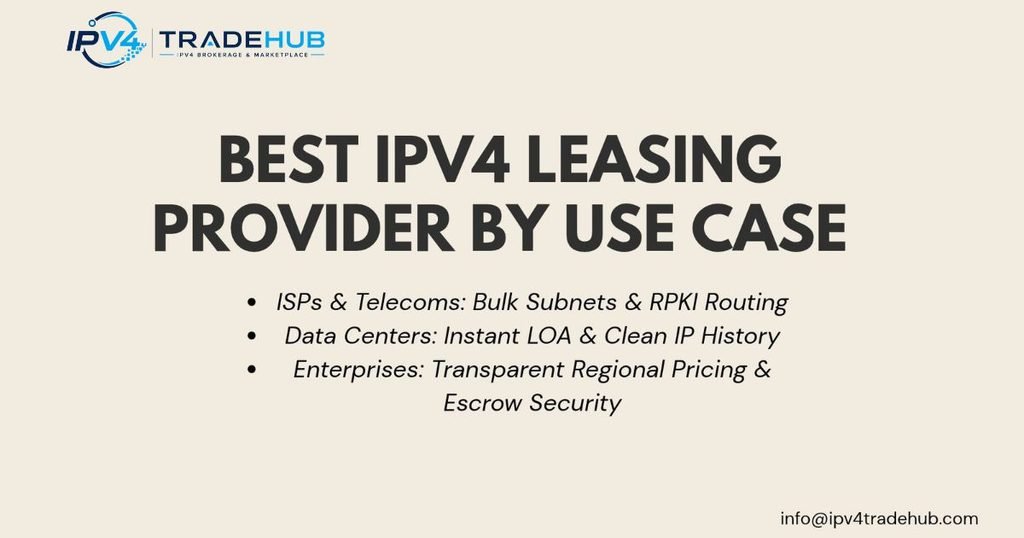
Best IPv4 Leasing Provider for ISPs and Telecoms
Telecommunications firms need stable space and clean routing. Look for RPKI help, clear route origin records and strong lease continuity. A forced move means painful network changes. Pick a lease provider with long terms and a steady link to the resource holder.
Best IPv4 Leasing Provider for Hosting Providers and Data Centers
Hosting providers need flexible IP block size options. They also need full DNS delegation and fast PTR record changes. Customers expect working reverse DNS. Pick a company that supports quick delivery and steady growth. Ask how fast new blocks arrive.
Best IPv4 Leasing Provider for Startups and Small Businesses
Small teams need low entry cost and simple onboarding. Look for a small IPv4 subnet leasing option such as a /24 block. Monthly billing helps cash flow. Skip long contracts at first. Start small and grow once your traffic proves itself.
Best Budget-Friendly IPv4 Leasing Provider
Budget buyers chase the lowest price per IP. That can backfire. Clean IP vs cheap IP is a real trade-off. A cheap block with bad history costs more in fixes. Add setup fees, support limits and swap rules to your math before you choose.
IPv4 Lease Pricing in 2026: What to Expect
IPv4 pricing usually follows a monthly model. You pay a monthly lease cost per address. Larger blocks often cost less per address. Reputation and region also move the price. Shop across several IPv4 leasing providers because quotes vary a lot.
Do not stop at the sticker price. Use this formula: lease price vs total operating cost. Add engineering time, fixes, replacement risk and migration cost. A low quote can turn costly fast. The table below shows illustrative ranges only. Check live pricing pages before you plan.
| IP block size | Addresses | Illustrative monthly range | Typical buyer |
|---|---|---|---|
| /24 | 256 | About $75 to $155 | Startups and small hosts |
| /23 | 512 | About $150 to $310 | Growing hosting firms |
| /22 | 1,024 | About $300 to $615 | ISPs and larger platforms |
These figures assume roughly $0.30 to $0.60 per IP each month. Real quotes may differ.
Hidden Fees That Inflate Your IPv4 Lease Bill
Watch for setup fees and LOA or RPKI charges. Some firms charge for rDNS setup or support tiers. Others add minimum terms and early exit fees. A swap request may cost extra too. Ask for a full fee sheet in writing before you sign.
What Pushes IPv4 Lease Prices Up or Down
Several things shape the final bill. Bigger blocks usually lower the price per IP. Hot RIR regions can raise it. A strong IP reputation raises it too. Long contracts often earn discounts. Tight IP geolocation needs can add cost as well.
How to Choose an IPv4 Leasing Provider: 8 Key Factors
A cheap quote can turn expensive after launch. Problems often show up only in production. You might face a blacklisted IP, a broken route or wrong location data.
1. RIR Coverage (ARIN First for US Buyers)
An RIR is a regional registry. The five are RIPE, ARIN, APNIC, LACNIC and AFRINIC. US buyers often want ARIN space. Yet some workloads need space from other regions. Confirm that your chosen IPv4 address lessor can supply the region you need.
2. Pricing Transparency
Clear pricing builds trust. Ask for the monthly lease cost, setup fees and renewal rates in writing. Compare quotes on the same IP block size. If a company hides fees until late in the process treat that as a warning sign.
3. Reputation History and Blacklist Screening
A single IP blacklist check does not tell the whole story. Reputation history includes past use, abuse history and routing history. Check for any spam blacklist listing. Ask about IP delisting help. Request test addresses so you can confirm you get a clean IP address.
4. Routing Readiness: LOA, IRR and RPKI ROA
Before you can announce a block you may need a Letter of Authorization (LOA). You may also need IRR records and an ROA (Route Origin Authorization). Decide which ASN will originate the block. Ask who prepares each record and how fast they can fix errors.
5. Geolocation Accuracy and Reverse DNS Control
Databases such as MaxMind may place one address in different cities. That hurts ad verification and regional tools. Test the IP geolocation database your customers use. Also ask who controls PTR record edits and reverse DNS changes.
6. Contract Terms and Payment Flexibility
Read the contract slowly. Look at term length, notice period and renewal pricing. Ask about the replacement policy if a block goes bad. Check payment options such as card, wire or invoice. Flexible terms let you adapt as your needs change.
7. Provisioning Speed
Speed matters when a launch date is near. Ask how long it takes to deliver a block after you sign. Delays often come from verification, paperwork and routing changes. Get a written timeline. A fast partner saves you from lost revenue.
8. Support, Monitoring and Replacement Policy
Trouble often starts after go-live. Ask who handles routing incidents, abuse reports and location errors. Look for 24/7 help and clear escalation paths. Strong IP remediation and monitoring protect your workload performance. A solid swap policy gives you a safety net.
How IPv4 Leasing Works: Step-by-Step Process
The process runs from first quote to live traffic. You choose a lease IP block, pass checks and sign. Then you set up routing records. Last you start the BGP announcement. Each step has small traps. Plan for them early.
Timelines vary by company and region. Paperwork and identity checks often slow things down. Routing changes can add a few days too. If you have your network configuration ready in advance you will move faster. Ask your upstream provider to confirm they accept the new route.
Step 1 to Step 6 at a Glance
Follow the table below from top to bottom. It keeps your team aligned and your launch on schedule. Skipping the test step is the most common mistake. A short trial often saves weeks of cleanup later.
| Step | Action | Key detail |
|---|---|---|
| 1 | Define your needs | Region, IP block size and workload |
| 2 | Shortlist providers | Compare price and features |
| 3 | Pass verification | Business ID and use case |
| 4 | Test sample IPs | Check reputation and location |
| 5 | Sign the LOA and set up ROA and IRR | Confirm the origin ASN |
| 6 | Announce and monitor | Prefix announcement via BGP |
What Happens When Your Lease Ends
When a lease ends you can renew or move out. Review the notice period well ahead of time. If you leave you must clean up DNS records, firewalls, customer allowlists and BGP policies. Plan this work early. A rushed exit can cause outages.
IPv4 Leasing Compliance, Risks and Legal Considerations
US buyers should follow ARIN rules and keep records tidy. Check the WHOIS record for the leased block. Confirm that the resource holder has the right to lease it. Good IPv4 leasing providers run identity checks. They also keep clear paperwork for every deal.
Common risks include a blacklisted IP, abuse complaints and vague contracts. Sanctions screening may also apply. Ask a lawyer to review your agreement. A tax advisor can explain how lease costs affect your books. This guide is general information. It is not legal advice.
Reputation, Abuse and Blacklist Risks
Past misuse can follow a block for years. Ask for test IPs and run your own checks. Review abuse history and look for a spam blacklist listing. Ask what IP delisting help is included. Document everything. Your records help if a dispute starts.
Contract Clauses to Review Before You Sign
Read these clauses with care: replacement policy, notice period, liability, abuse handling and termination rights. Check who pays when a block gets listed. Confirm how fast the IPv4 address provider responds to problems. Clear terms protect both sides and prevent surprise bills.
Final Verdict: Which IPv4 Leasing Provider Should You Choose?
Match the company to your needs. Self-service buyers may like IPXO. Buyers who want custom deals may like IPv4.Global. Hands-off teams may prefer PubConcierge. Operators who want direct supply with routing help may look at LARUS. Budget buyers should compare several quotes.
Ready to move? Request quotes from two or three finalists. Ask for test IPs and a full fee list. Then run your own IP blacklist check and location tests. Careful comparison of IPv4 leasing providers will give you a best IPv4 leasing provider match for your team. Good luck!
Ready to Find the Right IPv4 Leasing Provider for Your Business?
Stop guessing and start comparing. Request quotes from two or three finalists, test sample IPs and check pricing, routing support and contract terms before you sign. Pick the provider that fits your workload and budget.
It depends on your skills and workload. Teams with strong network staff may like a self-service marketplace. Teams that want help may prefer a managed company. Test sample IPs from two or three finalists. Then choose the one that performs best.
Not always. Each company supplies certain regions only. US buyers often want ARIN space. Some use cases need RIPE or APNIC space instead. Ask each provider which RIR regions it covers. Also check that the space fits your use case.
Yes. Leasing is a common practice. Still you must follow ARIN rules and your contract. Make sure the resource holder has the right to lease the space. Ask a lawyer to review the agreement. Keep records of every step.
It ranges from hours to a few weeks. Verification, paperwork and routing setup drive the timeline. Self-service platforms can move fast. Custom deals may take longer. Ask for a written delivery estimate before you sign.
RPKI lets the address owner sign a record that says which ASN may announce a block. That record is the ROA. It helps stop route hijacks. Many networks now check it. Learn more from ARIN’s RPKI page.