
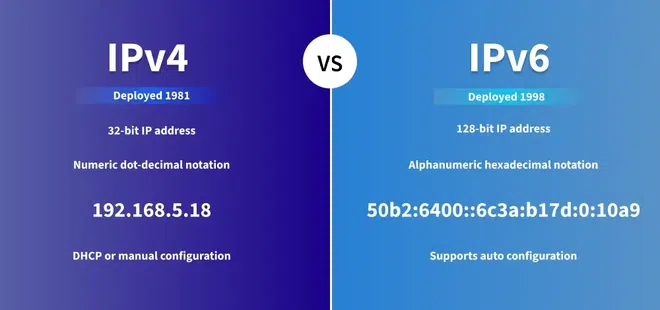
The internet works through IP addresses to recognize different devices. The two basic protocols are IPv4 and IPv6. The fourth version is IPv4 that has been common since the early days of the Internet. Nevertheless, IPv4 has a small address space, and thus IPv6 helps in providing more address space and better functionality. Businesses, ISPs, as well as network administrators need to know the difference between IPv4 and IPv6. This guide discusses difference between IPv4 and IPv6, major migration issues, and feasible solutions to a smooth-sailing transition
Insight on Key Difference Between IPv4 and IPv6
Address Length
IPv4 addresses are 32 bits, which permits approximately 4.3 billion addresses. The IPv6 addresses are 128-bit long, which gives it a virtually inexhaustible supply of IP addresses. This allows each device to have a different address. Hence, this is a solution to the scarcity problem by IPv4 networks as more devices are part of the internet.
Address Format
When you buy IPv4 address know that they come in decimal in four blocks divided by dots (e.g., 192.168.1.1). The IPv6 addresses are represented in hexadecimal with colons between them (e.g., 2001:0db8:85a3:8a2e:0370:7334). Hence, this modification facilitates the increased address space and enables easy and efficient management of more than one device.
Header Complexity
IPv4 headers have various fields with routing, checksums, and options, hence slowing down the packet processing. The IPv6 headers are made simpler and have fewer fields, hence the routing process is faster and more efficient in the network. Hence, this reduces processing overhead and improves the overall performance of current high-speed networks.
Security Features
IPv4 has optional security using external protocols such as IPsec. IPv6 also incorporates IPsec as a default capability, which encrypts and authenticates at the end-to-end. This guarantees better built-in protection of data transmission throughout the internet, and the confidential information is not exposed by the use of other settings.
Configuration and Management
IPv4 may be manually configured or use DHCP to assign addresses. IPv6 lease also permits automatic address configuration via Stateless Address Autoconfiguration (SLAAC) and hence simplifies network administration. This decreases the administrative work and makes devices capable of connecting to networks fast and consistently without the help of human resources.
Broadcast vs Multicast
IPv4 relies on broadcast to transmit data to all the devices on a network, thereby resulting in congestion. IPv6 does not use broadcast, and instead, it uses multicast and anycast, transmitting data to specific devices only. This increases the efficiency of the network, minimizes the traffic and improves the performance of large-scale deployments.
Significant Benefits of IPv6 Over IPv4
Expanded Address Space
IPv6 offers a massive address space compared to IPv4. This supports the rise in the quantity of internet-connected gadgets, such as smartphones, IoT devices, and smart systems. Networks can be expanded with IPv6 without the fear of address congestion, and successful and continuous connectivity is guaranteed.
Better Routing Efficiency
The simplified format of the IPv6 header and the hierarchical addressing system allow routing to occur faster and more efficiently. Internet routers are able to handle packets at lower delays, which enhance performance of the network. IPv6 allows large-scale networks to enjoy reduced congestion, latency, and improved traffic control.
Enhanced Security
IPv6 has built-in security features such as IPsec, which has the default encryption and authentication. This makes data transmission secure over the networks. Organizations acquire enhanced security against cyber threats and data breaches without the need to use extra tools and settings.
Automatic Device Configuration
It occurs when the system is booted up, and every device present on it is configured automatically. Automatic device configuration is done by booting the system, and every device that is available in the system gets configured automatically.
Effective Data Transportation
IPv6 eradicates any broadcasts and creates multicast and anycast, which disseminates information to targeted audiences. This reduces redundant network traffic, network congestion, and improves performance. This is common particularly in a setting where there are numerous devices part of the network or massive data streams.
Future-proof Network Infrastructure
IPv6 is compatible with the emerging digital ecosystem, such as the IoT, cloud computing, and smart cities. By implementing IPv6, companies are always ready to meet the new technology in the future. This provides scalable, secure and high-performance network operations in the long term.
Migration Challenges from IPv4 to IPv6
The process of switching between IPv4 and IPv6 may be difficult and has to be planned thoroughly. Always take better guidance from best IPv4 broker. Organizations might experience a limitation on hardware because the older hardware might not be IPv6-compatible. Programs and software might require some upgrades or compatibility tests. IT personnel should have the best education on new protocols, security policies as well as routing strategies.
Dual-stack networks, which are compatible with both IPv4 and IPv6, are complex in the migration process. Firewalls, NAT, and DNS configurations should be changed. A test is necessary to avoid network failures. A smooth migration requires phased deployment strategies, documentation, and continuous monitoring, which will reduce the impact on the services and users.
FAQs: Common Questions People Often Ask
1. What is the key difference between IPv4 and IPv6?
IPv4 addresses are 32 bits, IPv6 addresses are 128 bits, which means that there are a huge number of unique IP addresses.
2. What is the importance of IPv6 migration to businesses?
The IPv6 migration will provide scalability, enhanced security, and the presence of modern devices and IoT networks.
3. Is it possible to have IPv4 and IPv6 sharing the same network?
Dual-stack deployment is indeed possible, and IPv4 and IPv6 can co-exist without affecting connectivity.
4. What are the major challenges to IPv6 conversion?
Issues are compatibility, cost, security threats, dual-stack management and complexity of address planning.
Unlock Your Network’s Potential with IPv4 TradeHub!
Upgrade, trade, or manage IPv4 addresses effortlessly with IPv4 TradeHub. Simplify migrations, expand your network reach, and secure critical IP assets. Our platform ensures fast, compliant, and cost-effective IPv4 trading for enterprises, ISPs, and startups. Don’t let IPv4 scarcity limit growth! Experience seamless transactions, robust security, and expert support.