
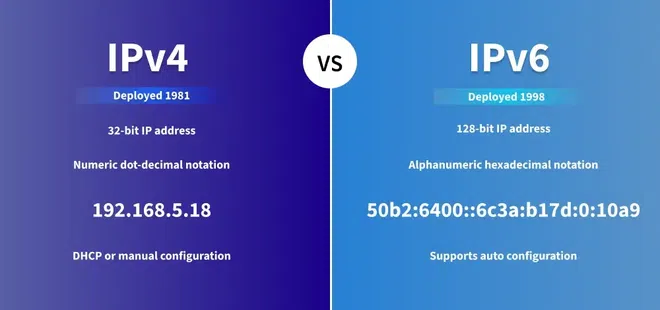
IPv4, the long-standing Internet Protocol, uses 32-bit addresses, supporting about 4.3 billion unique devices. In contrast, IPv6 uses 128-bit addresses, offering virtually unlimited connectivity to meet today’s digital expansion. Beyond address capacity, IPv6 enhances security, simplifies network configuration, and improves data routing efficiency. For businesses and IT professionals, transitioning to IPv6 ensures scalability, future-proofing, and seamless support for the growing ecosystem of connected devices. This guide explores the key insights on IPv4 or IPv6 comparison.
IPv4 or IPv6 Comparison: Key Differences to Know
Address Length
The IPv4 addresses are numeric values of 32 bits. It provides approximately 4.3 billion unique addresses. By contrast, IPv6 addresses are 128-bit hexadecimal. It offers a virtually unlimited number of identifiable addresses to meet the ever-increasing number of devices that need to be connected to the internet in the world. This growth will be scalable to future digital growth.
Header Complexity
The header format of IPv4 is simpler, and hence processing is faster. But it does not offer much more. When you buy IPv6 address know that it has a more advanced header, better streamlined routing and security. This has been making it more efficient over a large network. This layout facilitates the current network demands without affecting the speed.
Security Features
IPv4 uses external protocols to secure it, such as IPsec, which needs to be configured manually. IPv6 is available with security and has built-in encryption and authentication. This provides integrity and privacy of data by default and is therefore common to enterprises dealing with sensitive data.
Address Configuration
IPv4 is commonly configured by hand or through DHCP to assign addresses, which is not convenient. IPv6 has an automatic address configuration feature called Stateless Address Autoconfiguration (SLAAC), which eliminates administrative overhead and makes it easier to deploy to large networks.
Network Efficiency
The issues to lease IPv4 addresses include address scarcity, congestion, and routing constraints. IPv6 helps in overcoming these drawbacks through more efficient routing protocols that do not need extra network translation layers and reduce latency. This promotes a seamless data movement in complicated infrastructures.
Mobility Support
IPv6 is a mobile network-oriented protocol as it enables the transfer of devices across networks without IP conflicts. In contrast to IPv4, which is supported by more protocols, the approach to IPv4 mobility is typically complex and overhead-intensive.
Compatibility
When you rent IPv4 address know that it has been extensively used in older systems and devices. The use of IPv6 is on the increase, but it needs careful application with the current IPv4 infrastructure. It should use a dual-stack implementation as a prerequisite to maintain backward compatibility without loss of service.
IPv4 or IPv6 Comparison: Common Sector Using it
Old systems in banking, medical care, educational institutions, and production still rely on IPv4. In such sectors, long-established networks rely on well-tested protocols. IPv6 is also gaining huge popularity among cloud service providers, telecommunication providers, and internet enterprises. These sectors have massive address requirements and security demands. The future industries, such as IoT, smart cities, and mobile networks, are using IPv6 to enhance network accessibility, automated network setup, and network performance.
In transitional environments, a hybrid installation is common. Here, different businesses can combine the legacy compatibility of the environment with the next-generation networking advantages. Comprehensively, IPv4 and IPv6 are complementary to one another based on industry demands and the level of maturity of technology.
IPv4 or IPv6 Comparison: Which is Costlier?
The use of IPv4 is getting scarce, thus making it expensive for businesses that require more public addresses. Companies can either use costly NAT solutions or purchase IP addresses, which impose a financial burden on the companies.
Implementing IPv6 is associated with the initial capital expenditure on infrastructure upgrades, training, and network redesign. Nevertheless, it reduces the expenditure in the long-term perspective, as it removes the dependence on NAT and facilitates automated control.
Thus, the implementation of IPv6 can be costly in the short term. It secures networks against the vagaries of time and prevents the situation of the soaring cost of IPv4 scarcity. Essentially, IPv4 has hidden costs in the long-run operations. Hence, IPv6 is less costly in operation to businesses that intend to expand their network on a sustainable and large scale.
IPv4 or IPv6 Comparison: Which One Is Best?
The selection of the most suitable protocol depends on the requirements of the network. IPv4 is also good to use in smaller networks and legacy systems, and provides ease of use and wide compatibility. IPv6 is most beneficial in large networks that are modern and more extensive in nature. They are available with virtually unlimited addresses, built-in security, and efficient routing.
IPv6 is scalable and automated. This is beneficial to the business planning to integrate IoT, cloud computing, or connect internationally. Dual-stack usage in practice provides organizations with the ability to use both protocols in the transition. Finally, IPv6 is the solution to the big, safe, and efficient networks in the future, when IPv4 is still the reliable provider of the existing infrastructure. The choice must be strategic and based on technological growth.
Get Best Control on IP Resources with IPV4 TradeHub
Ready to take control of your IP resources? At IPV4 TradeHub, we provide premium solutions for businesses that demand reliability, scalability, and seamless connectivity. Whether you are expanding infrastructure or optimizing network performance, our expert-driven marketplace ensures secure, fast, and cost-effective IP address transactions.