
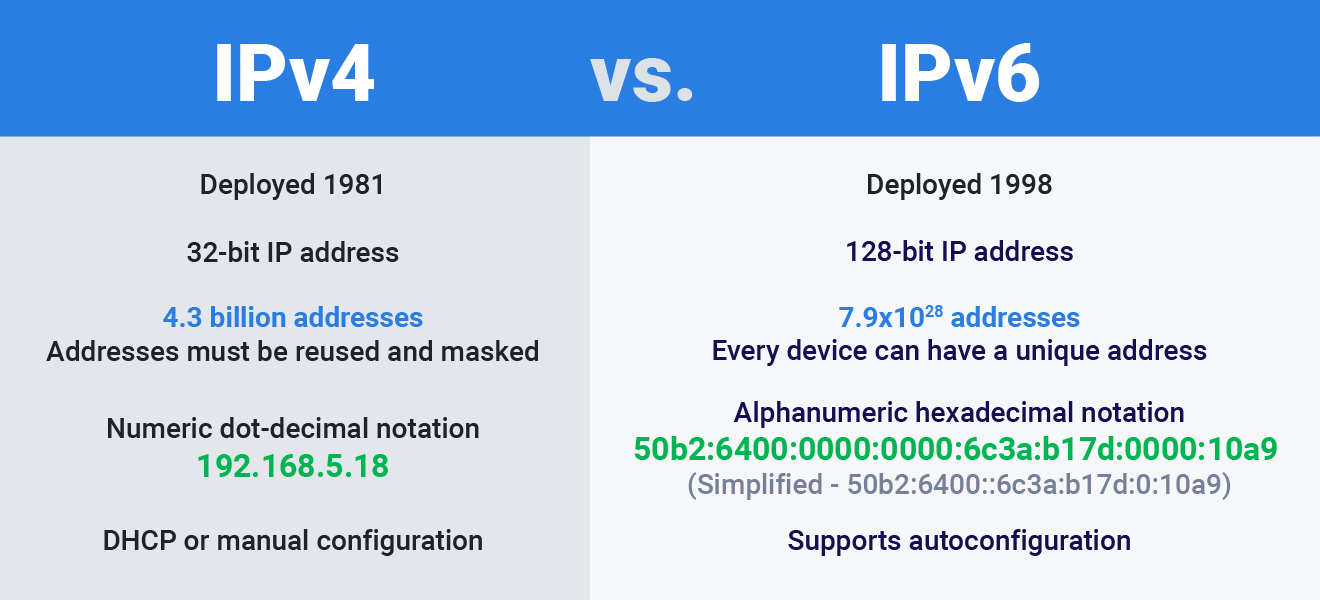
IP addresses are the basis of the internet, and they consist of unique number identifiers of assigned devices. The two major versions, IPv4 and IPv6, are very important in networking. Although IPv4 has had control over the internet over the decades, IPv6 was formed to address the constraints of IPv4, including address exhaustion. It is important to differentiate IPv4 and IPv6 addresses to know how helpful network administrators, businesses and tech enthusiasts are in building effective connectivity and scalable solutions.
Reasons to Differentiate IPv4 and IPv6 Address
It is important to differentiate IPv4 and IPv6 address to manage a network today. The 32-bit numbering system of IPv4 is unable to keep up with the explosive population of connected devices, whereas the IPv6 system has 128-bit addresses, which guarantee practically unlimited unique identifiers.
Knowledge of their differences enables IT teams to plan for scalability, routing optimization and gain security. When you buy IPv6 address know that it also has simpler network configuration and enhanced multicast routing. In the case of the business, the differentiation of these protocols guarantees compatibility with the new technologies, IoT devices, and cloud infrastructures.
Being able to identify the peculiarities of both organizations will enable them to introduce effective networks, address conflicts, and ensure efficient communication between different platforms.
Key Aspects to Differentiate IPv4 and IPv6 Address
Address Length
The IPv4 addresses are in 32-bit format, which is usually in a decimal format with four octets separated by dots. IPv6 addresses are available in 128 bits, which are written in hexadecimal using colons. This growth enables IPv6 to accommodate infinitely more devices, which will prove useful in terms of future network needs.
Address Format
While you lease IPv4 addresses know that it is not only familiar and limited, but it uses a dotted-decimal system, like 192.168.0.1. IPv6 operates on hexadecimal standards, such as 2001:0db8:85a3::8a2e:0370:7334. This might seem confusing, but it allows addressing hierarchy, better routing and enhanced understandability of large-scale networks.
Address Space
IPv4 also allows approximately 4.3 billion addresses, which is not enough to cover the world. IPv6 increases this space exponentially by 340 undecillion addresses, which is enough to provide a unique identifier to each device, sensor, and application. This generosity eliminates the necessity of network address translation and enables the internet connectivity to proceed in a smooth manner.
Configuration Method
While you rent IPv4 address understand that it is frequently available in manually or dynamically with DHCP servers. IPv6 has stateless address autoconfiguration (SLAAC), which optimizes administrative load and facilitates the smooth connectivity of mobile and IoT devices.
Security Features
IPv4 security is rather optional and, in many cases, depends on additional protocols, such as IPSec. IPv6 has built-in support of IPSec, which adds encryption and authentication on an end-to-end basis. This built-in security improves data integrity and privacy on contemporary networks without the need for complicated add-on settings.
Routing Efficiency
The use of address hierarchies and NAT may cause fragmentation of IPv4 routing. IPv6 provides simpler, hierarchical routing and aggregated prefixes, enhancing efficiency and decreasing the size of tables. This will help in decreasing latency, which is essential in the context of enterprise-level and cloud-based networks.
Interoperability and Interaction
It is not necessarily compatible between IPv4 and IPv6, and transition systems, such as dual-stack, tunneling, or translation, are required. These differences are critical to understanding to enable organizations to have backward compatibility. They hence transition to IPv6 at a gradual rate without necessarily interfering with the current activities of the network.
Differentiate IPv4 and IPv6 Address: Pros & Cons
IPv4 has 32-bit addresses and can support a maximum of 4.3 billion devices, whereas IPv6 has 128-bit addresses and can support an almost infinite number of addresses. IPv4 is less complex, more popular, and straightforward to set up, yet it has address exhaustion and must use NAT when using a large network.
IPv6 carries no address shortage, greater routing efficiency, and built-in security (IPSec), but is less widely adopted. It may have problems with compatibility with older systems, and is more difficult to configure.
The advantages of IPv4 are familiarity and ecosystem support, whereas the advantages of IPv6 are scalability, futureproofing, and advanced features. The full shift towards IPv6 guarantees the expansion and performance of the network in the long term, which meets contemporary connectivity requirements.
Differentiate IPv4 and IPv6 Address: Which is Better?
The decision between IPv4 and IPv6 is based on the size of the network, the security requirements, and future preparation. IPv4 is still adequate for small, stable networks with few devices, which provide familiarity and wide compatibility.
Nonetheless, IPv6 is superior in terms of scalability, security, and efficiency. This is why it is suitable to be used in modern enterprises, cloud services, and IoT implementations. IPv6 has no address exhaustion, auto-configuration, and simplified routing, and offers long-term sustainability.
Organizations that want to grow, improve their performance, and futureproofing should consider the use of IPv6. Finally, IPv6 is the standard of the next generation. It provides the possibility to have secure, flexible, and globally compatible networks to meet the changing technological needs.
FAQs: Common Questions People Often Ask
1. What is the key difference between IPv4 and IPv6?
IPv4 addresses are 32 bits, and IPv6 addresses are 128 bits. They both provide an enormous number of addresses and are much better scaled.
2. What is the need to have IPv6 when there is IPv4?
IPv6 addresses the IPv4 address exhaustion and offers better security, mobility and auto-configurations.
3. Can IPv4 and IPv6 coexist?
Yes, dual-stack networks can be used to have both IPv4 and IPv6 running in parallel to ease transition.
4. Is IPv6 faster than IPv4?
IPv6 has the potential to enhance efficiency in routing, although the speed is determined by the network infrastructure and the support of the ISPs.
5. What does IPv6 do to increase security?
IPv6 provides secure authentication and encryption through IPsec, which is superior to the optional IPsec of IPv4.
Boost Your Network Connectivity with IPV4 TradeHub
Unlock premium IPv4 addresses instantly with IPV4 TradeHub, the leading marketplace for businesses and ISPs. Expand your network, secure reliable addresses, and ensure smooth digital growth with verified, ready-to-use IPv4 blocks. Don’t let IPv4 scarcity limit your business. Explore our marketplace now and futureproof your network today!