Internet Protocol version 6 (IPv6) is the most recent version of the Internet Protocol. This address helps to identify and locate devices within a network. Previously, IPv4 was popular but had a limited number of IP addresses. But over time, a wide range of internet devices proliferated at an alarming rate. To address this problem, IPv6 was something that came to the forefront. It has a significantly bigger address space and enables billions of additional devices to be connected. This guide provides complete details on how many IPv6 addresses are there, their structure and range.
Overview of How Many IPv6 Addresses Are There
IPv6 (Internet Protocol version 6) offers a staggering number of unique addresses in contrast to IPv4. It has a 128-bit space, with a maximum of around 3.4 × 1038 addresses. Such a large number of identifiers ensures that no device, sensor, or system on Earth runs out of addresses.
IPv6 helps to accommodate the increasing number of internet devices, unlike IPv4, which is in deplete and restrict state. This transparency also provides a superior network structure, scalability, and future expansion. Hence, IPv6 is crucial for the further development of the global internet infrastructure.
Understanding the Structure of IPv6 Addresses
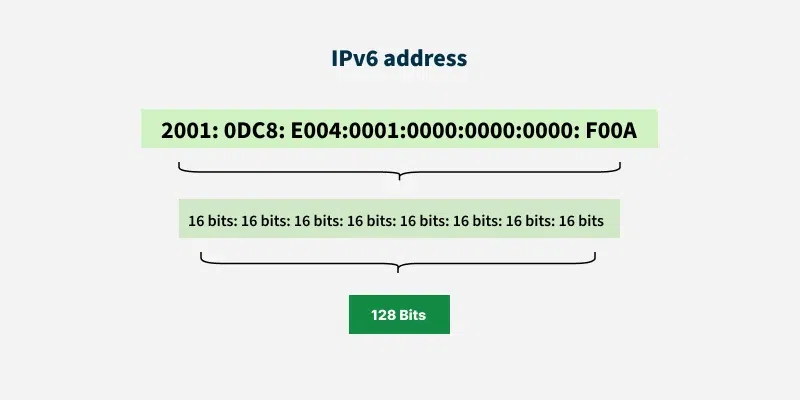
When you buy IPv6 address know that it is available in the format of 128 bits, and it is represented in the hexadecimal format. It is divided into eight blocks of four characters. These groups are categorized using colons, which makes the address easy to read and handle. Hence, the complete address has 16 bits divided into segments. For example, an IPv6 address looks like this: 2001:0db8:85a3:0000:0000:8a2e:0370:7334.
To make it easier to write, leading zeros may be omitted, and two or more parts of zeros may be compressed with a double colon (::). This structure provides high representation efficiency and an extremely scalable, flexible address space for modern networks.
IPv6 Addresses Range Explained
The range of IPv6 addresses is extremely vast, spanning from 0000:0000:0000:0000:0000:0000:0000:0000 to ffff:ffff:ffff:ffff:ffff:ffff:ffff:ffff. This range contains every conceivable combination of 128-bit values, corresponding to an almost unimaginable number of distinct addresses.
IPv4 has a restricted range of approximately 4.3 billion addresses. Hence, IPv6 is sufficient to allocate trillions of addresses to every square meter of Earth’s surface. This large scale guarantees long-term viability of the internet. Hence, this makes it feasible to allocate, subnet, and route hierarchically, ensuring global connectivity and the future of digital technologies.
Significant Benefits of IPv6 Addresses Over IPv4
Vast Address Space
IPv6 offers a vast address space, which has removed the shortage problems that were coming in IPv4. This guarantees that all devices can have distinct IP addresses without using Network Address Translation. Hence, this makes networks easier to use, run and administer. The large number of available addresses is also conducive to the proliferation of the Internet of Things and future technologies. This will enable it to expand globally without being constrained by IPv4 address exhaustion.
Improved Security Features
IPv6 is security-conscious and has integrated IPsec (built-in) that provides encryption, authentication as well as integrity of data. This improves secure communication among devices and minimizes vulnerabilities that are prevalent in IPv4 networks. The idea of leasing IPv6 addresses provides a stronger foundation for protecting data and preserving privacy in contemporary networks.
Effective Routing and Network Performance
IPv6 enhances routing efficiency by making packet headers simpler and reducing the processing required by routers. This results in accelerated data transmission and enhanced network performance. Hierarchical addressing enables routers to manage traffic more effectively, reducing congestion and enhancing scalability. Consequently, IPv6 networks can provide high-speed, more reliable communication, which is vital for new applications and services.
Improved Mobile Devices Support
The plan of IPv6 selling also increases the support of mobile devices by such features as stateless address autoconfiguration and enhanced mobility protocols. Devices can automatically set their IP addresses without manual configuration or DHCP IPv6 adoption plan also increases support for mobile devices through features such servers. Hence, this facilitates easy movement of devices between networks without losing connectivity. With the ever-increasing use of mobile devices, IPv6 enables reliable, continuous communication across a wide range of network setups.
Challenges for Implementation of IPv6 Addresses
Interoperability with Existing Systems
Compatibility with the existing IPv4 infrastructure is one of the primary challenges of implementing IPv6. Most older devices, applications and systems are not IPv6-compatible and may need upgrades or a dual-stack setup. This may become a complex and expensive process. Thus, organizations have to make sure that the IPv4 and IPv6 systems are compatible with each other, without interfering with existing systems or operations.
Transition Complexity
The transition from IPv4 to IPv6 is not a one-day event; it is a planned, well-executed process. Network administrators need to adopt either dual-stack systems or tunnelling to ensure connections remain intact until the transition period. Such complexity raises the overhead of the operations and requires specialised knowledge. This makes the process of migration time-consuming and less technical for many organizations.
Unawareness and Training
One barrier to implementing IPv6 is the lack of awareness and training among IT professionals. Most network engineers still know more about IPv4, so they are reluctant to embrace IPv6. Companies might have to invest in training and education to ensure their staff can properly handle IPv6 networks, which slows universal adoption.
Upgrade Your IP Strategy with IPV4 TradeHub Today!
Looking to buy, sell, or lease IP addresses with confidence? IPV4 TradeHub is your trusted marketplace for secure, fast, and reliable IPv4 transactions worldwide. Whether you are scaling your business, expanding infrastructure, or optimizing network resources, our expert-driven platform ensures seamless deals and competitive pricing. Don’t let IP limitations slow your growth. Partner with us and unlock new opportunities in global connectivity.