
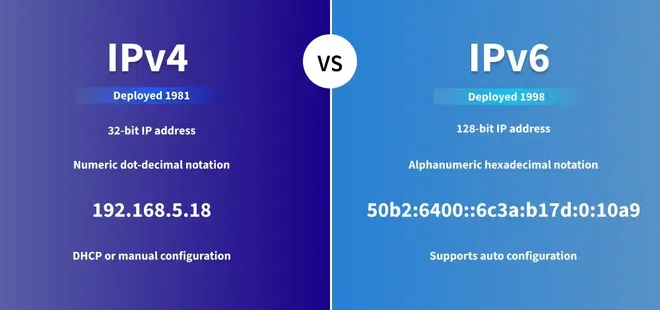
Internet Protocol (IP) is a basic system which enables devices to communicate and exchange data via the Internet. It establishes a clear guideline on the transmission and reception of information. The significance of IP addresses is that they distinguish each device and allow data delivery. In the modern world, the two predominantly used IP versions are IPv4 and IPv6. This is because knowing the difference between IPv4 vs IPv6 is essential to businesses, service providers, developers, and the future development of the global internet.
IPv4 vs IPv6: Key Differences Explained
1. Address Format
IPv4 has a 32-bit address format, which is represented by four numbers with dots. IPv6, on the contrary, is a 128-bit format with eight sets of hexadecimal digits. The difference enables IPv6 to provide a significantly larger number of addresses. These are in demand due to the increasing number of internet-reliant devices.
2. Address Space
IPv4 has the capacity of 4.3 billion addresses, and this is no longer adequate to accommodate the international internet demands. IPv6 offers a huge virtual address space (trillions of devices) and is virtually unlimited. This guarantees future-proofing of growing networks and removes the use of highly complex workarounds (Network Address Translation).
3. Header Complexity
IPv4 headers are smaller and more complicated to handle since they have optional fields. IPv6 is more straightforward in its headers, with extra fields being eliminated and simplifying the processing of packets. This improves network performance and lowers latency. Hence, it also helps to improve the current applications, such as streaming and online games.
4. Security Features
IPv4 is dependent on other protocols like IPsec to provide security, which should be configured separately. The IPv6 protocol incorporates IPsec directly into the protocol and offers enhanced end-to-end encryption and authentication. This built-in protection is essential in those companies that deal with sensitive information.
5. Configuration and Mobility
It is common that IPv4 utilizes manual setup or DHCP servers. It is important to pick best IPv4 broker to understand the configuration properties. IPv6 has automatic configuration enabled in stateless address autoconfiguration. This simplifies the setup of the devices, enhances the mobility of the network and manages large-scale networks efficiently.
6. Network Efficiency
IPv4 necessitates the use of NAT to remedy the shortage of addresses, which may slow down networks. IPv6 does not require NAT, and the devices can communicate directly. This increases performance, minimizes latency, and increases reliability in general, which makes the networks more efficient to use in the modern internet.
Significant Advantages of IPv4 vs IPv6
IPv6 has a few excellent benefits compared to IPv4. Its most interesting feature is a much bigger address space, which can serve trillions of devices. It has better security, which has inbuilt IPsec, and faster routing. Thus, it has simplified headers and automatic configuration that enables easy network management. IPv6 also gets rid of NAT, which makes the connection between the current networks easier and more effective.
Moreover, IPv6 supports mobile and internet of Things. This will ensure the future-proofing of networks with the increased number of internet-connected devices worldwide. By contrast, when you buy IPv4 address, you will find it to be more established and can support the old systems. But it is ineffective and inefficient in the modern-day, growing digital environment.
Major Drawbacks Between IPv4 vs IPv6
IPv4 has a limited address space that necessitates workarounds to enable the association of more than one device, such as NAT. It is also based on additional security protocols, which complicates it. Though it has more addresses and better features, IPv6 is not adopted as fast as it has compatibility problems with legacy systems. Not all older hardware and software is fully compatible with IPv6, which may pose a transition problem.
Besides, IPv6 may have a steep learning curve for network administrators used to IPv4. It is also possible that organizations will have to spend money on training and updating infrastructure. Although they have their benefits, there are weaknesses to these two protocols that should be addressed with caution.
IPv4 vs IPv6: Which One is Better?
The choice between IPv4 and IPv6 lease would be based on your network requirements. IPv4 is a mature and accepted protocol, and it is compatible with a lot of devices. This makes it a reliable option to use in the existing systems. IPv6, however operated in the future, has an almost unlimited address space, enhanced security, and enhanced network efficiency. IPv6 is more appropriate in growing businesses and where the Internet of Things is relied on.
On the contrary, IPv4 is adequate for small and well-established networks. Dual-stack deployment is the most common form of deployment as both protocols are used simultaneously, although compatibility is ensured with gradual conversion to IPv6. Finally, the next standard is IPv6, the next generation, which is, however, not that bad now.
FAQs: Common Questions People Often Ask
1. Is IPv4 still relevant today?
IPv4 is still extensively popular, but IPv6 is becoming more demanding. This is due to the default of addresses, enhanced protection and scalability in the future that exist globally on the networks.
2. What is better about IPv6 as compared to IPv4?
IPv6 has a much bigger addressing space. This makes it possible to support billions of devices. It has ease of routing and effective handling of internet applications in the contemporary world.
3. Can IPv4 and IPv6 work together?
IPv4 and IPv6 can be used together through a dual stack, tunnelling, and translation methods. This enables a gradual transition without disturbing current services in the world today.
4. Is IPv6 more secure than IPv4?
IPv6 will enhance security by mandatory support of IPsec, simplified headers, and dependency on NAT. This will ensure better end-to-end connectivity in modern networks.
Power Your Network with IPv4 TradeHub Services
Ready to power your network with reliable IP resources? IPv4 TradeHub connects businesses with premium IPv4 addresses through secure, transparent, and fast transactions. Whether you’re expanding infrastructure, supporting legacy systems, or balancing IPv4 and IPv6 strategies, our marketplace delivers verified assets, expert support, and competitive pricing. Join us today to buy, sell, or lease IPv4 addresses confidently, minimize downtime, and keep your digital operations running smoothly worldwide.