
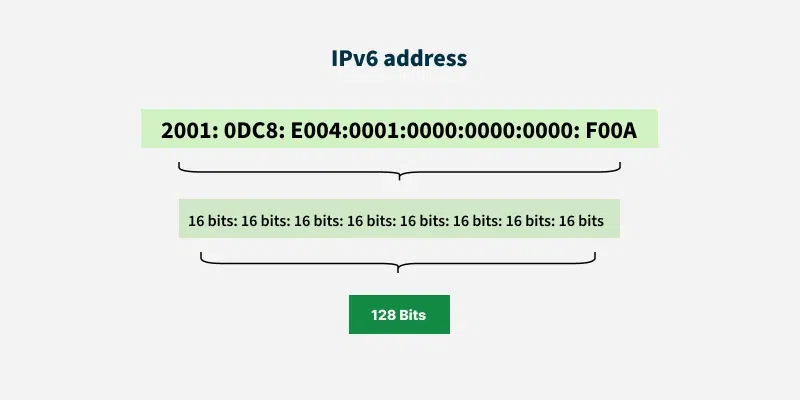
The fast growth of devices connected to the internet has brought an urgent necessity to have a more scalable system of Internet Protocol addresses. The limitations of IPv4 have raised the major need to introduce IPv6 (Internet Protocol version 6). An IPv6 address is a 128-bit alphanumeric number. It has an allocation with various devices to any network for facilitating communication without any hitches throughout the internet. This guide explores some more insights about what is IPv6 address, its format, types and addressing rules.
Overview of What Is IPv6 Address
Internet Protocol version 6, popular as IPv6, is the most recent internet addressing system, which is a perfect replacement of IPv4. It offers an extremely larger address space where each device gets a unique identification. In addition to scalability, IPv6 also promotes efficiency in routing, eases management of networks, and improves security.
When you buy IPv6 address, know that it favours the use of modern technologies like cloud computing, IoT, and mobile networks. The positive effects of the connectivity are that it gives businesses and consumers reliable connectivity, improved performance, and reduces network complexity. Its use will make the internet sustainably grow.
Different Types of IPv6 Address to Know
Unicast Address
A unicast IPv6 helps to identify a single device in the network. Transmission of information to a unicast address gets a receiving from one recipient only, which provides accurate one-to-one communications. This kind of address is mostly common to servers, individual computers and devices in the network. It helps in making it possible to have a reliable connection without unnecessary network traffic.
Multicast Address
Multicast addresses help to transmit data to many recipients at the same time. This technique causes the network to be more efficient, making it suitable for video streaming, conferencing, and group communications. Multicast also guarantees that one data set gets the sharing among multiple devices without repeating network traffic. Meanwhile, it conserves bandwidth and enhances the overall performance.
Anycast Address
A single IPv6 address is easy to share by multiple devices with the use of an anycast address. The network automatically directs data to the closest or most efficient device, enhancing response time and reliability. This type of address is typically applicable in content delivery networks (CDNs) and distributed services. Hence, it helps in offering faster access and higher redundancy to the important applications.
Insights on Format and Structures of IPv6 Address
Addresses in IPv6 are 128 bits in length and are normally available in eight blocks of four hexadecimal numbers joined with colons. Leading zeros within a block are drop through, and successive blocks of zeros gets a compressing with a double colon (: :). It supports unicast, multicast and anycast addresses, each having a network role. Such a format enhances readability and management.
IPv6 also allows effective routing with hierarchical address space assignment. This results in smaller routing tables and ensures better network performance. Its logical architecture can automatically set up addresses, scale smoothly, and enhance the use of modern applications such as IoT, cloud computing and mobile connectivity.
Significant Benefits of Using IPv6 Address
Larger Address Space
The idea to lease IPv6 addresses offers a practically unlimited address pool, solving the problem of IPv4 scarcity. Each device may possess a different IP address, and it will be connected continuously. This extended addressing facilitates the development of the global network, serving billions of new devices. It will provide a means of seamless communication at the personal, enterprise, and IoT levels.
Improved Security
IPv6 has built-in IPsec security to enable authentication and encryption, which enhances network security. Confidential information can be sent without extra security measures to ensure the safety of users and organizations. In-built security also makes it easier to comply and provide safer communication within any network.
Efficient Routing
IPv6 makes routing hierarchical, and addresses are allocated hierarchically, which minimizes the complexity of routing tables. Aggregated network addresses enhance efficiency and reduce latency, and enhance network performance. This method will help businesses, cloud services and international internet to have faster traffic and more reliable delivery of data.
Simplified Network Configuration
IPv6 has automatic address configuration, which enables the devices to automatically assign themselves the addresses without being configured. This cuts down on the administration overhead, eases mass network deployment, and increases scalability. Businesses can roll out new devices in a short period of time, simplify IT management, and sustain effective connectivity over the growing infrastructures.
Better Support for Modern Applications
IPv6 offers powerful addressing and communication paradigms to the emerging technologies like IoT, cloud computing and mobile networks. Its design facilitates the smooth connection of devices, the transfer of data at a higher speed and better reliability. Hence, modern applications can be efficiently performed with appropriate adjustments to the increasing global network demands.
Challenges for Implementing IPv6 Address
There are technical and operational difficulties in the implementation of IPv6 selling. Legacy IPv4 systems can have compatibility problems with organizations. To take care of IPv6, IT teams require special training to handle and troubleshoot. The network equipment, software and firewalls must be improved or changed, which can be expensive.
The transition planning is important to ensure the connectivity, security and performance. Moving large-scale networks requires coordination among service providers, partners, and internal teams. Although the benefits prove to be long-term, the initial process may be quite time-consuming. Hence, it is necessary to test, monitor, and introduce it gradually to avoid disruptions and guarantee an increase in all devices and applications.
Upgrade Your Network Strategy with IPV4 TradeHub
Take control of your IP infrastructure with IPV4 TradeHub, the trusted marketplace for buying, selling, and leasing IPv4 addresses. IPV4 TradeHub provides reliable transactions, professional services, and a reasonable price depending on your objectives. Increase your network capacity nowadays using our platform and stay at the forefront in the changing digital environment.