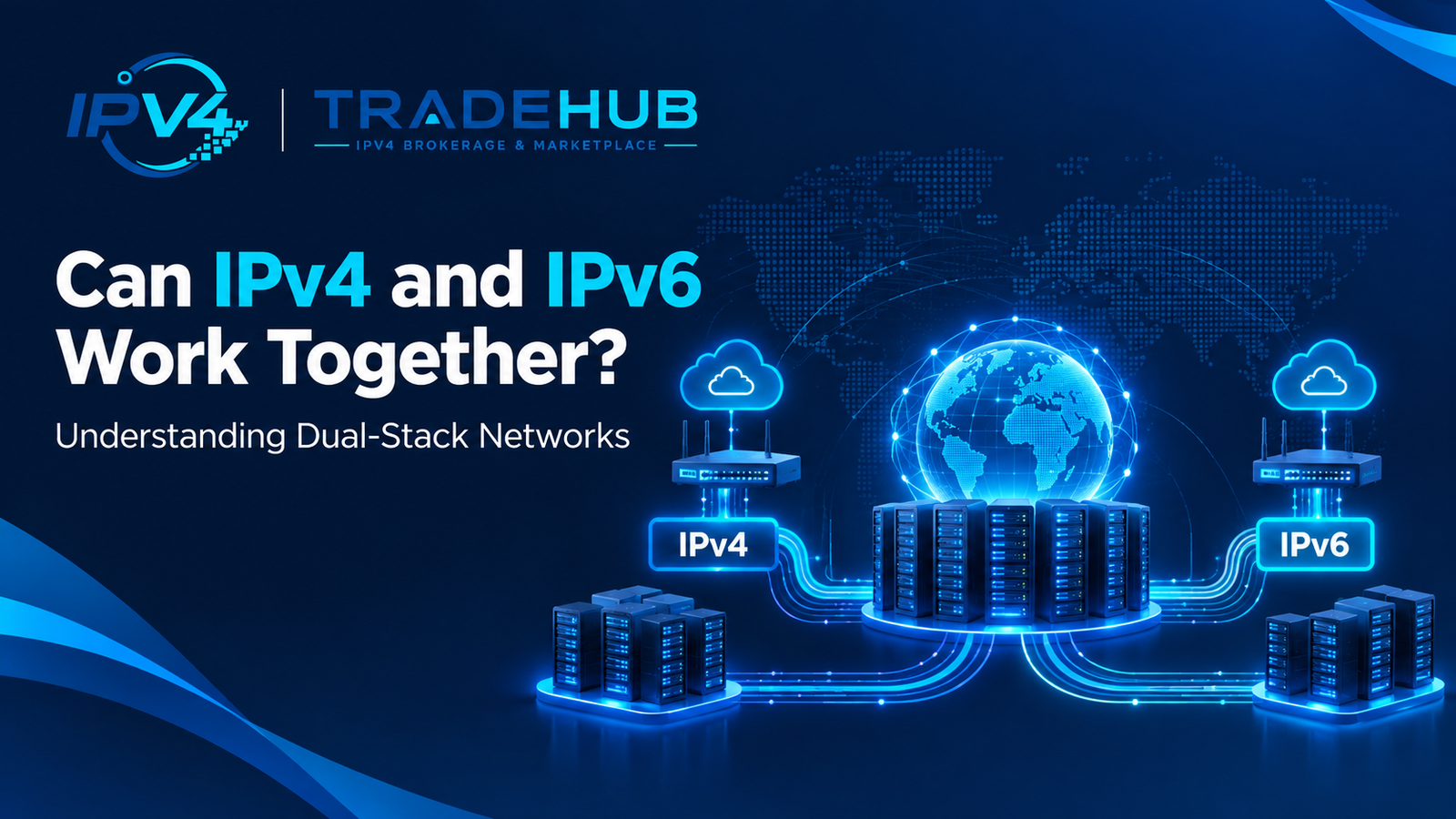
As internet infrastructure continues to evolve, businesses are increasingly managing both IPv4 and IPv6 networks. This raises an important question: Can IPv4 and IPv6 Work Together? The answer is yes. Both protocols can operate on the same network through a configuration commonly known as dual-stack networking.
IPv4 has been the foundation of internet communication for decades, while IPv6 was developed to provide a much larger address space and support the continued growth of connected devices. According to the Internet Engineering Task Force (IETF), IPv6 uses 128-bit addresses compared with the 32-bit addresses used by IPv4.
Rather than requiring businesses to immediately replace IPv4 infrastructure, dual-stack networking allows organizations to support both protocols. This approach can help maintain compatibility with existing systems while enabling newer IPv6-capable devices and services.
In this guide, we will explain how IPv4 and IPv6 coexist, how dual-stack networks work, their benefits, challenges, and what businesses should understand when managing both protocols.
What Is IPv4?
IPv4, or Internet Protocol version 4, is one of the core communication protocols used to identify devices and route data across IP networks.
IPv4 addresses contain 32 bits, allowing for approximately 4.3 billion theoretical address combinations. The rapid expansion of websites, cloud services, smartphones, connected devices, and other internet-connected systems contributed to the depletion of available IPv4 address space.
Despite the development of IPv6, IPv4 remains deeply integrated into internet infrastructure. Many networks, applications, servers, and devices continue to depend on IPv4 connectivity.
For businesses operating existing infrastructure, maintaining access to IPv4 can therefore remain an important part of network planning.
What Is IPv6?
IPv6, or Internet Protocol version 6, was developed as the successor to IPv4. One of its most significant differences is its address size.
IPv6 uses 128-bit addresses, providing an enormously larger address space than IPv4. The protocol also introduces changes to addressing, packet handling, autoconfiguration, multicast, and other aspects of IP networking.
The expanded address capacity makes IPv6 suitable for the continued growth of internet-connected infrastructure. It can provide organizations with a scalable addressing framework as networks expand.
However, IPv6 does not automatically replace IPv4. Because the two protocols are different, organizations need suitable mechanisms to support environments where IPv4 and IPv6 are both required.
Can IPv4 and IPv6 Work Together?
Yes, IPv4 and IPv6 can work together.
The most straightforward approach is called dual stack. Under a dual-stack configuration, a device, server, router, or network supports both IPv4 and IPv6.
The IETF describes dual IP layer operation as a transition mechanism that provides support for both protocols. A dual-stack host can communicate with IPv4 systems using IPv4 and IPv6 systems using IPv6.
This means an organization does not necessarily have to abandon its existing IPv4 infrastructure when introducing IPv6.
For example, a server could have:
- An IPv4 address for IPv4 communication
- An IPv6 address for IPv6 communication
- Network equipment capable of handling both protocols
- Applications configured to support the appropriate protocol
When a connection is established, the network and application environment can determine which protocol is used.
What Is a Dual-Stack Network?
A dual-stack network is an environment where IPv4 and IPv6 operate simultaneously.
Instead of converting IPv4 addresses into IPv6 addresses, the network maintains both protocols. Each protocol has its own addressing and routing behavior.
Consider a business with a web server that supports both protocols. An IPv4-only user can connect using IPv4, while an IPv6-capable user may connect using IPv6.
This arrangement can be useful during the long transition between IPv4-dependent infrastructure and broader IPv6 adoption.
The IETF’s transition documentation identifies dual stack as one of the mechanisms designed to support coexistence between IPv4 and IPv6.
How Does Dual-Stack Networking Work?
Dual-stack networking may appear complicated, but the basic concept is straightforward.
1. Devices Support Both Protocols
A dual-stack device has IPv4 and IPv6 functionality enabled. Depending on the operating system, router, server, or application, both protocols can have addresses assigned simultaneously.
2. DNS Can Provide Both Address Types
A domain can have both an A record for IPv4 and an AAAA record for IPv6.
When a client looks up a domain, it may receive information about the available IPv4 and IPv6 addresses.
3. The Client Establishes a Connection
A compatible client can attempt to establish communication using IPv6 or IPv4 depending on network conditions, application behavior, and address availability.
4. Routers Handle the Selected Protocol
Network routers and other infrastructure need appropriate IPv4 and IPv6 routing configurations. IPv4 traffic follows IPv4 routing, while IPv6 traffic follows IPv6 routing.
5. Applications Continue Serving Users
If an application supports both protocols correctly, users can reach the service regardless of whether their network uses IPv4 or IPv6.
This is one reason dual-stack networking can be useful for businesses that need to support different types of customers and infrastructure.
Why Do Businesses Use IPv4 and IPv6 Together?
There are several practical reasons for maintaining both protocols.
Existing IPv4 Infrastructure
Many organizations already have servers, applications, firewalls, routers, monitoring systems, and other infrastructure built around IPv4.
Replacing everything at once can be complex and disruptive.
A dual-stack approach allows businesses to introduce IPv6 while continuing to operate their IPv4 infrastructure.
IPv6 Adoption
IPv6 provides a much larger address space than IPv4. Organizations expanding their networks can therefore benefit from supporting IPv6 alongside their existing addressing infrastructure.
Compatibility
Not every network or service supports IPv6 in the same way. Some users may still connect through IPv4-only networks.
Supporting both protocols can help businesses maintain connectivity across different environments.
Gradual Network Transition
Moving from one protocol environment to another can take time. Dual-stack networking allows organizations to introduce IPv6 progressively instead of treating the transition as a single large infrastructure change.
IPv4 and IPv6 Are Not the Same Protocol
It is important to understand that IPv4 and IPv6 are not simply two versions of the same address format.
They use different address structures, packet headers, routing behavior, and configuration mechanisms.
IPv4 uses 32-bit addressing, while IPv6 uses 128-bit addressing. IPv6 also includes features designed to improve scalability and address configuration.
Because of these differences, simply assigning an IPv6 address to an IPv4-only system does not automatically make the system IPv6-compatible.
The relevant devices, operating systems, applications, DNS configuration, security controls, and routing infrastructure must support IPv6 where required.
What Are the Benefits of Dual-Stack Networking?
Dual-stack deployment can provide several operational advantages.
Continued IPv4 Compatibility
Businesses can continue serving customers and systems that depend on IPv4 while introducing IPv6 connectivity.
Support for IPv6 Growth
Organizations can begin supporting IPv6-enabled users, applications, and infrastructure without immediately removing IPv4.
Flexible Network Architecture
Supporting both protocols gives network administrators additional options when designing or expanding infrastructure.
Gradual Migration
Businesses can introduce IPv6 in stages and evaluate compatibility before making broader changes.
Wider Connectivity
A service available through both protocols can potentially communicate with IPv4-only and IPv6-capable networks.
What Challenges Should Businesses Consider?
Although dual stack provides flexibility, operating two protocols also introduces additional management requirements.
More Configuration
Network administrators need to configure and maintain IPv4 and IPv6 addressing, routing, firewall policies, monitoring, and troubleshooting.
Security Management
Security policies need to account for both protocols. An organization that secures IPv4 traffic but overlooks IPv6 traffic could create configuration gaps.
Monitoring
Network monitoring tools should be capable of identifying IPv4 and IPv6 traffic so administrators can investigate connectivity and performance issues accurately.
Application Compatibility
Some older applications may have limited IPv6 support. Businesses should therefore verify application and infrastructure compatibility before expanding IPv6 deployment.
Operational Knowledge
IT teams may need additional IPv6 knowledge covering addressing, subnetting, routing, DNS, security, and troubleshooting.
Does Dual Stack Mean IPv4 Is Being Replaced?
Not immediately.
Dual-stack networking is better understood as a coexistence strategy rather than an instant replacement process.
IPv6 was designed as the successor to IPv4, particularly because of IPv4’s limited address space. However, existing IPv4 infrastructure remains widespread.
This is why businesses may operate both protocols for an extended period.
For organizations managing internet infrastructure, the practical question is often not whether IPv4 or IPv6 must disappear immediately, but how both can be managed effectively according to their technical requirements.
How Businesses Can Prepare for Dual-Stack Networking
Organizations considering dual-stack deployment should first understand their current infrastructure.
Important areas to review include:
- Routers and switches
- Servers and operating systems
- DNS configuration
- Firewalls and security systems
- Cloud infrastructure
- Hosting environments
- Applications and APIs
- Monitoring and logging platforms
- Internet service provider support
Businesses should also document their IPv4 and IPv6 addressing arrangements so that administrators can understand which systems use each protocol.
For organizations that need additional IPv4 resources while expanding IPv6 infrastructure, options such as lease IPv4 address arrangements can provide access to IPv4 address space for a defined period.
Similarly, businesses planning IPv6 deployment may evaluate Lease IPv6 options depending on their network requirements and available address resources.
Is IPv6 Better Than IPv4?
IPv6 and IPv4 serve different requirements, and there is no need to treat dual-stack networking as a simple competition between the two protocols.
IPv6 provides a significantly larger address space and was designed to support the continued expansion of internet connectivity. IPv4, meanwhile, remains widely deployed across existing networks and services.
For many organizations, the practical approach is to understand where each protocol is required and ensure the network can handle the relevant traffic.
A business may therefore operate IPv4 and IPv6 simultaneously rather than making an immediate all-or-nothing choice.
What About Businesses That Need IPv4 Addresses?
Although IPv6 adoption continues to develop, many businesses still require IPv4 resources for existing infrastructure, customers, applications, hosting environments, cloud deployments, and network services.
The IPv4 market includes options for organizations that need additional address space. IPv4 TradeHub provides services related to buying, selling, and leasing IPv4 resources and supports businesses looking for IPv4 address blocks.
Businesses evaluating available address resources may also encounter IPv4 for sale listings when looking for longer-term IPv4 requirements.
The appropriate approach depends on factors such as network size, duration, infrastructure requirements, budget, and operational objectives.
Final Thoughts
So, Can IPv4 and IPv6 Work Together? Absolutely.
Dual-stack networking provides a way for organizations to operate IPv4 and IPv6 simultaneously. IPv4 can continue supporting established systems, while IPv6 provides a much larger address space for modern and expanding network infrastructure.
A successful dual-stack environment requires more than assigning addresses. DNS, routing, security, applications, monitoring, and network equipment all need to be considered.
For businesses planning their next stage of network growth, understanding how both protocols coexist can make infrastructure planning more predictable and flexible. IPv4 and IPv6 do not have to be treated as mutually exclusive technologies. With the right architecture, they can operate together as part of the same network environment.
Frequently Asked Questions
1. Can IPv4 and IPv6 work together on the same network?
Yes. IPv4 and IPv6 can operate simultaneously on the same network through a dual-stack configuration. Devices and network infrastructure can support both protocols and communicate using the appropriate protocol.
2. What is dual-stack networking?
Dual-stack networking is an approach where IPv4 and IPv6 are both enabled on network devices, servers, or hosts. It allows IPv4 systems to communicate through IPv4 while IPv6-capable systems can use IPv6.
3. Do IPv4 and IPv6 use the same address?
No. IPv4 and IPv6 use different addressing systems. IPv4 uses 32-bit addresses, while IPv6 uses 128-bit addresses.
4. Does IPv6 replace IPv4 immediately?
No. IPv6 was designed as the successor to IPv4, but existing IPv4 infrastructure remains widely deployed. Organizations can use transition and coexistence approaches such as dual stack.
5. Can a server have both IPv4 and IPv6 addresses?
Yes. A server can be configured with both IPv4 and IPv6 addresses. This allows it to communicate with clients using either protocol when the relevant network and application infrastructure supports it.
6. Does dual stack require special network equipment?
Network equipment must support both IPv4 and IPv6 functionality for a dual-stack deployment. This can include routers, firewalls, switches, operating systems, and network monitoring systems.
7. Is IPv6 faster than IPv4?
Neither protocol should automatically be considered faster in every situation. Actual performance can depend on routing, network configuration, connectivity, infrastructure, application behavior, and other factors.
8. Why do businesses still need IPv4?
Many existing applications, networks, customers, hosting environments, and online services continue to use IPv4. Businesses may therefore need IPv4 resources while they introduce or expand IPv6 support.
9. Can a website support both IPv4 and IPv6?
Yes. A website can be configured to support both protocols when its hosting infrastructure, DNS records, network, and server configuration are properly set up.
10. Is dual-stack networking a long-term solution?
Dual stack can provide a practical coexistence approach while organizations operate both IPv4 and IPv6. The appropriate network strategy depends on an organization’s infrastructure, applications, connectivity requirements, and IPv6 deployment plans.