
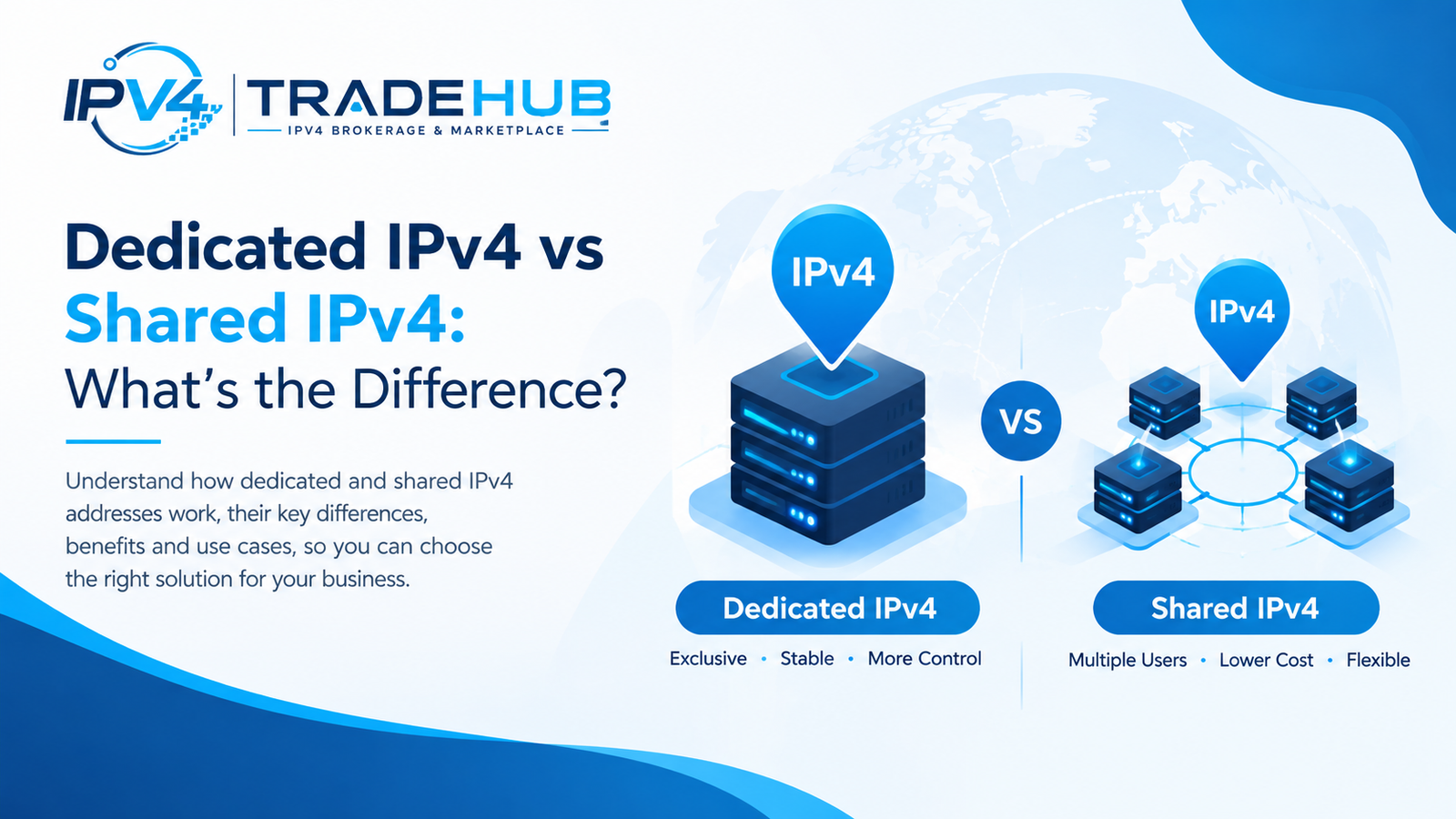
Choosing the right IP address setup can make a significant difference to how a business manages its network, servers, applications, and online services. Two common options are dedicated IPv4 addresses and shared IPv4 addresses. While both can provide IPv4 connectivity, they work differently and offer different levels of control, consistency, and resource separation.
For businesses operating websites, applications, remote systems, servers, email infrastructure, VPNs, proxies, or other internet-facing services, understanding this difference is important before selecting an IP address solution.
IPv4 addresses remain widely used across the internet, even as organizations continue adopting IPv6. The limited availability of IPv4 address space has also created an active market for IPv4 resources. ARIN, for example, depleted its general IPv4 free pool in September 2015, and organizations can now use mechanisms such as transfers to obtain IPv4 space where applicable.
So, what exactly separates a dedicated IPv4 address from a shared one? Let’s explore the differences, benefits, use cases, and factors businesses should consider.
What Is a Dedicated IPv4 Address?
A dedicated IPv4 address is an IPv4 address assigned exclusively to one customer, organization, server, or service. Other customers do not use the same public IPv4 address for their internet-facing activities.
This arrangement provides a consistent public IP that can be associated with a particular server, network, application, or business operation.
For example, a company may have a web server that uses one dedicated IPv4 address. When users connect to that service, the same public IPv4 address identifies the server.
Dedicated addresses can be useful when an organization needs predictable addressing, access controls, IP allowlisting, remote access, or services that depend on a stable public IP.
Businesses that need IPv4 resources can work with providers such as IPv4TradeHub to explore available IPv4 solutions for their infrastructure.
What Is a Shared IPv4 Address?
A shared IPv4 address is used by multiple customers, devices, websites, or services rather than being assigned exclusively to one customer.
Shared addressing is commonly associated with hosting environments, carrier-grade NAT, proxy services, and other infrastructure where many users operate behind the same public IPv4 address.
For example, several websites hosted on a shared hosting platform may appear on the internet through the same public IP address. Similarly, multiple users may access the internet through a shared public IPv4 address provided by an ISP or network operator.
Shared IPv4 can be practical when exclusive addressing is unnecessary. However, because the address is used by multiple parties, its reputation, traffic characteristics, and availability may be influenced by other users.
Dedicated IPv4 vs Shared IPv4: Key Differences
The primary distinction is ownership or assignment at the service level.
With a dedicated IPv4 address, the address is allocated for exclusive use by a particular customer or service. With a shared IPv4 address, multiple users or services operate through the same public address.
Here are the main differences:
| Feature | Dedicated IPv4 | Shared IPv4 |
|---|---|---|
| Usage | Exclusive to one customer/service | Used by multiple users/services |
| IP consistency | Stable and predictable | Shared among multiple users |
| Reputation | More isolated | Can be affected by other users |
| Access control | Easier to manage | More complicated |
| Allowlisting | Straightforward | Less suitable |
| Cost | Generally higher | Generally lower |
| Control | Greater | More limited |
| Typical use | Servers, business systems, remote access | Shared hosting, general connectivity |
The right option depends on how the address will be used and whether your infrastructure requires exclusive public addressing.
Benefits of a Dedicated IPv4
1. Consistent IP Address
One of the biggest advantages of a dedicated IPv4 address is consistency.
A business can configure applications, firewalls, DNS records, access controls, and other systems around a known public IP address. This can simplify network administration and reduce complications associated with changing addresses.
For services that need a predictable endpoint, a dedicated address can provide a straightforward setup.
2. Better Control Over IP Reputation
A dedicated IP separates your traffic from the traffic generated by other users.
With a shared IP, another customer’s activity can potentially affect how the address is perceived by external services. A dedicated IPv4 reduces this type of dependency because the address is associated with your own service or organization.
This can be particularly relevant for businesses operating internet-facing applications or services where consistent IP behavior matters.
3. Easier IP Allowlisting
Many organizations use IP allowlists as part of their security controls.
For example, a company may configure a firewall or third-party platform to permit connections only from specific public IP addresses. A dedicated IPv4 can make this easier because the organization has a stable address that can be registered with the relevant system.
Shared addresses can make this more complicated because the same public IP may represent multiple users.
4. Suitable for Business Infrastructure
A dedicated IPv4 can be useful for infrastructure that requires a stable public endpoint.
Examples include:
- Business servers
- VPN gateways
- Remote-access systems
- Web applications
- Hosting environments
- Network management systems
- Certain email infrastructures
- Security appliances
- API services
The exact requirements depend on the application and network architecture.
5. Greater Separation From Other Users
With shared addressing, multiple customers operate behind the same public IPv4 address.
Dedicated addressing creates greater separation at the public IP level. This does not automatically make a network secure, but it can simplify traffic identification, firewall rules, logging, and access management.
Benefits of Shared IPv4
Shared IPv4 addresses also have legitimate uses and can be appropriate for many users.
Lower Cost
Because an address can be used by multiple users, shared infrastructure can reduce the cost of providing internet connectivity or hosting services.
This makes shared addressing attractive for applications where exclusive public addressing is not required.
Efficient Use of IPv4 Resources
IPv4 addresses are limited resources. Sharing public addresses through technologies such as NAT allows many private devices to communicate through fewer public IPv4 addresses.
This approach has become an important part of extending the usability of the existing IPv4 address space.
Suitable for Basic Connectivity
A typical user browsing websites, streaming content, using cloud applications, or performing everyday internet activities may not need an individually dedicated public IPv4 address.
In these cases, shared addressing can provide the connectivity required without the additional cost or management associated with dedicated addressing.
When Should You Use a Dedicated IPv4?
A dedicated IPv4 may make sense when your business requires a stable and individually assigned public address.
Consider dedicated addressing if you need:
- A fixed public IP for a server
- IP-based access controls
- Reliable allowlisting
- A consistent endpoint for remote access
- Separation from other customers
- Greater control over IP reputation
- Specific network or application requirements
- A public address for business infrastructure
For example, a business operating a remote-access VPN may configure its firewall and user access policies around a specific public IPv4 address. Changing that address frequently could require additional configuration.
Similarly, an organization operating an application that connects with external partners may need to provide those partners with a stable IP address for allowlisting.
When Is Shared IPv4 Enough?
Shared IPv4 can be suitable when exclusive public addressing isn’t necessary.
For example, basic web browsing, many shared hosting environments, and ordinary internet connectivity can work effectively with shared public IPv4 addresses.
If multiple users can operate through the same public address without affecting the application’s functionality, paying for a dedicated address may not provide a meaningful benefit.
The important consideration is not whether one approach is universally better, but whether the addressing model matches the technical requirements of the service.
Dedicated IPv4 for Servers and Hosting
Servers are one of the most common situations where businesses consider dedicated IPv4 addresses.
A dedicated address can provide a predictable endpoint for a server and simplify DNS configuration, firewall policies, monitoring, and external integrations.
For businesses managing multiple servers, IPv4 requirements can also become more complex. Different services may need separate addresses depending on their architecture and operational requirements.
Organizations looking to acquire additional IPv4 resources may explore options to buy IPv4 address depending on their infrastructure requirements and the applicable transfer or provider arrangements.
Dedicated IPv4 and Email Services
Email infrastructure is another area where businesses may consider dedicated addressing.
Email providers and security systems evaluate various signals when processing messages. IP reputation can be one factor among many. When multiple unrelated users send traffic through a shared public address, their activity is associated with that same address.
A dedicated IPv4 can provide greater separation at the IP level.
However, having a dedicated IP does not automatically guarantee email deliverability. Configuration, authentication, sending practices, domain reputation, content, recipient engagement, and provider policies can all influence whether messages reach their intended destinations.
Dedicated IPv4 and Remote Access
Remote-access systems can benefit from stable public addressing.
Businesses may configure VPNs, firewalls, secure gateways, or administrative systems around a fixed IP address. Employees, contractors, or trusted partners can then connect to a known endpoint.
A dedicated IPv4 can also simplify allowlisting when access should be limited to specific addresses.
The security of the system still depends on proper authentication, encryption, firewall configuration, access controls, and monitoring. A dedicated IP is an addressing solution, not a replacement for security controls.
What Does IPv4 Exhaustion Mean for Businesses?
IPv4 has a theoretical address space of approximately 4.3 billion addresses. The rapid growth of internet-connected devices and services contributed to the exhaustion of available IPv4 pools.
ARIN’s general IPv4 free pool was depleted on September 24, 2015. Today, organizations seeking IPv4 resources may encounter different processes depending on their regional Internet registry and circumstances. ARIN identifies waiting lists, transfers, and other policy mechanisms as options for organizations seeking IPv4 space.
IPv4 address transfers have therefore become an important part of the current IPv4 ecosystem. ARIN states that regional registries permit registration of IPv4 transfers between address holders, helping redistribute existing address space.
For businesses, this means IPv4 planning can be an important part of long-term network infrastructure management.
Buying vs Leasing IPv4 Addresses
Businesses looking for dedicated IPv4 resources may encounter both purchasing and leasing options.
Purchasing or acquiring IPv4 space can provide a longer-term resource depending on the transaction structure and applicable registry policies. Leasing, on the other hand, provides temporary use of address space under an agreement with the lessor.
ARIN explains that IPv4 leasing can be an alternative to purchasing IPv4 space or waiting for resources, but leasing does not provide the lessee with permanent registration rights or network autonomy. When a lease ends, the lessor can require the addresses to be returned.
Businesses should therefore understand the contractual, registry, technical, and operational terms before selecting an IPv4 solution.
How to Choose Between Dedicated and Shared IPv4
Start by identifying what your application actually requires.
If your business needs a stable public endpoint, IP allowlisting, dedicated infrastructure, or greater separation from other users, a dedicated IPv4 may be appropriate.
If your primary requirement is ordinary internet access and there is no need for an exclusive public address, shared IPv4 may be sufficient.
Consider these questions:
- Does the service require a fixed public IP?
- Do external systems need to allowlist your IP?
- Are you operating a public server?
- Does IP reputation matter to your application?
- Do you need separation from other customers?
- How many IPv4 addresses does your infrastructure require?
- Is long-term ownership important, or would leasing meet the requirement?
- What are the provider’s registration and transfer terms?
Answering these questions can help define the most appropriate addressing model.
Final Thoughts
The difference between dedicated and shared IPv4 ultimately comes down to how the public address is used.
A dedicated IPv4 provides an exclusive, consistent public address that can be useful for servers, business applications, remote access, allowlisting, and other infrastructure requiring predictable addressing. Shared IPv4, meanwhile, allows multiple users or services to operate through the same public address and can be suitable for applications where exclusive addressing isn’t necessary.
As IPv4 resources remain constrained, businesses should consider their current infrastructure requirements as well as future network plans. IPv4 availability, transfer rules, leasing arrangements, and regional registry policies can all influence how organizations obtain and manage address space.
For businesses researching IPv4 for sale, understanding the difference between dedicated and shared addressing is an important first step before selecting an IPv4 provider or solution.
If your infrastructure requires exclusive addressing, you can also evaluate whether you need to purchase IPv4 addresses for longer-term requirements or explore leasing when temporary access is more appropriate.
For organizations specifically looking for a buy static IPv4 address solution, the key is to match the address type, quantity, technical requirements, and acquisition structure with the intended use.
Frequently Asked Questions
1. What is a dedicated IPv4 address?
A dedicated IPv4 address is a public IPv4 address assigned exclusively to one customer, service, server, or organization. It is not simultaneously used by unrelated customers for their public internet activity.
2. What is a shared IPv4 address?
A shared IPv4 address is a public address used by multiple users, devices, websites, or services. NAT and shared hosting are common examples of environments where public IPv4 addresses can be shared.
3. Is a dedicated IPv4 better for business servers?
A dedicated IPv4 can be useful for business servers when the server needs a stable public endpoint, IP allowlisting, remote access, or other IP-specific configurations. Whether it is necessary depends on the server’s architecture and requirements.
4. Does a dedicated IPv4 improve security?
A dedicated IPv4 does not automatically make a network secure. It can make IP-based access controls and network management easier, but security still depends on authentication, firewalls, encryption, monitoring, patching, and other controls.
5. Why do businesses use dedicated IPv4 addresses?
Businesses may use dedicated IPv4 addresses for servers, VPNs, remote access, applications, allowlisting, hosting, network infrastructure, and services that require a predictable public IP.
6. Can multiple websites use the same IPv4 address?
Yes. Multiple websites can operate on the same public IPv4 address, particularly in shared hosting environments. Web servers can use technologies such as virtual hosting to serve different domains from the same IP.
7. Are IPv4 addresses still available?
IPv4 availability depends on the region, provider, block size, and acquisition method. Regional Internet registries have exhausted their general free pools at different times, while transfers and other mechanisms continue to facilitate redistribution of existing IPv4 resources.
8. Can I lease a dedicated IPv4 address?
Yes, IPv4 leasing is an option offered through the market. However, leasing generally provides temporary use rather than permanent registration rights. The exact terms depend on the agreement and applicable registry policies.
9. What is the difference between buying and leasing IPv4?
Buying or acquiring IPv4 space can provide a longer-term resource depending on the transaction and registration arrangements. Leasing generally provides use of the addresses for a defined period under a contract with the address holder.
10. Does IPv6 replace dedicated IPv4?
IPv6 is designed to provide a much larger address space and is an important part of the internet’s long-term development, but IPv4 remains widely deployed. Many organizations therefore operate IPv4 and IPv6 together while transitioning their infrastructure.