
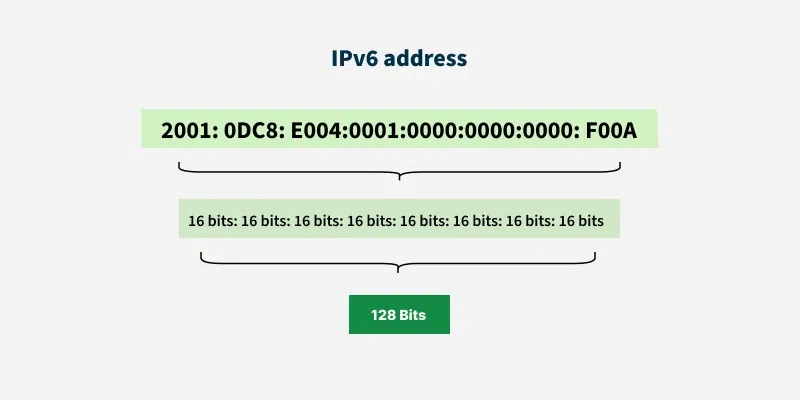
IPv6 is the latest version of the Internet Protocol created to replace IPv4 and overcome the shortage of available IP addresses. Unlike IPv4, which uses 32-bit addresses, IPv6 uses 128 bits to provide a vastly larger address space. These extra bits support billions of connected devices, advanced networking requirements, and future internet expansion. Understanding how many bits does IPv6 use helps businesses, network administrators, and organizations efficiently manage modern internet infrastructure.
How Many Bits Does IPv6 Use?
IPv6 uses 128 bits to generate every Internet address. With 128 bits, IPv6 can offer a vast number of unique addresses, compared with the 32 bits of IPv4. Generally, the longer address size is beneficial for the increasing number of devices getting an internet connection, such as computers, smartphones, servers, and smart devices.
IPv6 writes these bits into groups of six hexadecimal numbers, which are easier to organize and read. Networks can easily grow and never exhaust address space due to the 128-bit structure. This makes IPv6 a sound way to meet future expansion in global internet connectivity.
Understanding the 128-Bit IPv6 Address Structure
IPv6 is made up of 128 bits split into 8 blocks of 16 bits. These groups are represented in hexadecimal with colons between each group. This can give rise to an immeasurably large address space that can accommodate billions of devices globally. The 128-bit format of IPv6 comes with enough addresses to meet future demands of the internet compared to the 32-bit format of IPv4.
When you buy IPv6 address know that the structure also enables more efficient network organization, which it helps with better assignment of addresses to devices and networks. IPv6 addresses are longer and more complex. Their format is designed to make the internet system more efficient, scalable, and secure, keeping modern technologies in mind.
Key Reasons Why IPv6 Needs 128 Bits
Supports Massive Internet Growth
The number of devices on the internet continues to increase at a very rapid rate, and therefore IPv6 needs 128 bits. Computers, phones, smart appliances, cars, and such all require a unique address. There is no limit on the number of devices that can be connected to the network, giving connectivity to billions of devices to ensure digital technology expansion without shortage in the future.
Provides More Unique Addresses
IPv6 has a much larger address space than IPv4; the traditional structure of 128 bits provides much more room than the 32 bits used in IPv4. It can generate nearly 340 undecillions (a whopping number) of distinct addresses. This way, each device could have a different one. Hence, this availability helps minimize address conflicts and makes building up larger networks convenient for businesses, organizations, and users.
Improves Network Organization
IPv6 has improved address allocation and management with 128 bits. Such a systemtic design enables Internet service providers and companies to arrange their networks better. Hence, it enables hierarchical addressing, so routing processes are smoother and performance remains high as worldwide networks continue to expand.
Prepares for Future Technologies
The future technologies that rely on constant internet connection need 128 bits, which is what IPv6 has to provide. The number of addresses required for smart cities, artificial intelligence systems, connected vehicles, as well as the Internet of Things devices is very high. There is no limit to addresses in the large IPv6 address space for future innovations.
Does IPv6 Use More Data Because It Has 128 Bits?
Having 128 bits is the main reason why businesses prefer to lease IPv6 addresses. The only reason that IPv6 is 128 bits is not enough to mean that it consumes more data. Ipv6 addresses are longer due to the larger address size, but the size of additional network data is typically small. Above all, IPv6 additionally adds capabilities to enhance the effectiveness of the network, including fewer packet processing, and enhanced routing techniques.
The format of an IPv6 header is larger than that of an IPv4 header, but contemporary networks are constructed to cope with the difference. Having a large address space is worthwhile as the amount of data is trivial. IPv6 contributes to a faster, more reliable, and more scalable Internet environment for tomorrow’s connectivity needs.
Why Businesses Should Understand IPv6 Address Length?
IPv6 address length is important for businesses as it plays a crucial role in their future network design and digital expansion. The structure of the 128-bit IPv6 offers sufficient numbers of addresses to accommodate growing network sizes, Cloud Services, connected devices, as well as modern technologies. Businesses that know nothing about IPv6 selling can plan ahead for the move from IPv4 and escape future connection problems.
By understanding the basics of IPv6 and its implications, businesses can better manage their networks, scale them to meet growing demands, and ensure optimal performance. Businesses with innovative network solutions can help avoid breakage and incompatibility as more and more Internet service providers and platforms migrate to IPv6. One of the core elements of a future-proof digital infrastructure is the length of Internet Protocol version 6 addresses IP version 6 (IPv6).
Future of Ipv6 Address: What to Expect?
With the growing number of devices connected to the internet, the future of IPv6 addresses is bright. IPv6 offers an enormous address space, suitable for smart devices, cloud services, 5G networks, and emerging technologies. As organizations deal with limitations of IPv4, the adoption of IPv6 will continue to grow globally.
Better connectivity, security capabilities, as well as network management will prove beneficial for businesses. IPv6 will be the backbone of the modern internet, aiding connectivity and communication on billions of devices, and rapidly across global Internet networks in the coming years. It will further evolve as digital transformation progresses.
Secure Your Internet Future with Reliable IPv4 Address Solutions
Running a business that still depends on IPv4 connectivity? IPV4 TradeHub provides reliable IPv4 address solutions designed to support your networking requirements. Whether you need IPv4 resources for cloud services, enterprise networks, or digital infrastructure expansion, our trusted platform helps you access valuable IP resources with confidence.