
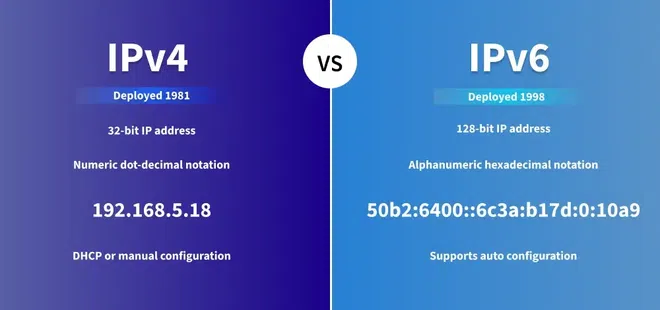
The internet uses IP addresses to locate and establish links between devices in networks. As the world goes digital, the change from IPv4 to IPv6 is gaining momentum. IPv4 is still common because it is simple and compatible, whereas IPv6 has a much larger address space and is much more efficient. The decision between IPv4 vs IPv6 which is best, lies in the requirements of scalability, preparedness of infrastructure, and the long-term objectives of business, in a rapidly emerging, globalized world.
Overview to Know IPv4 vs IPv6 Which Is Best
IPv4 and IPv6 are two fundamental protocols that allow devices to interact with networks IPv4 and IPv6. The IPv4, which has been in use for decades, has a constrained addressing system that is almost depleted. The purpose of IPv6 was to eliminate this limitation, with a much bigger address space, enhanced security capabilities, and enhanced efficiency.
Thus, IPv4 is still very popular because of its simplicity and its current infrastructure. There is a continuous rise in the use of IPv6 because of modern networks, which require scalability. The decision between IPv4 vs IPv6 which is best is based on the existing compatibility requirements and future expansion. Hence, in the present-day world, most organisations must work on a dual-stack environment to achieve stability and expansion awareness.
IPv4 vs IPv6 Which Is Best: Key Differences
Address Space
When you buy IPv4 address, know that it has a 32-bit system, which enables approximately 4.3 billion distinct addresses. IPv6, in its turn, is 128-bit, which gives the system a virtually unlimited number of addresses. This means IPv6 is much more appropriate to the current and growing networks and linked devices on the planet.
Address Format
Addresses in IPv4 are available in decimal numbers with a dot separating them and are therefore comparatively easy to read and memorize. The IPv6 addresses are in the hexadecimal form, in the division of colons, which looks more complex. Nevertheless, with this format, IPv6 can efficiently and orderly utilize its vastly greater address pool.
Security Features
The security of IPv4 is highly reliant on external protocols and configurations, which may be implemented differently. IPv6 lease was accessible in a way that considers security, and this has incorporated IPsec as one of its basic functions. This is an integrated security that improves authentication, confidentiality, and integrity of data. Hence, IPv6 is a more secure protocol to use in the new age of networking.
Configuration
IPv4 frequently needs the configuration by hand or by using DHCP servers to assign IP addresses. IPv6 makes this easier using auto-configuration, and devices can create their own addresses automatically. This cuts down on administration overhead, and IPv6 proves to be more efficient in large-scale deployment and in dynamic network environments.
Performance and Efficiency
When you buy IPv6 proxies, know that it enhances the effectiveness of the routing process by simplifying the packet header. It facilitates the simplification of data processing in the networks. IPv4, though operational, has some overhead in some operations. Consequently, IPv6 can provide performance with improvements in optimised environments. This is common with big and complex networks that need high-speed data processing.
Compatibility
IPv4 is still predominant and has the support by almost all devices and systems all over the world. The usage of IPv6 is growing, although not common. Dual-stack configurations and protocols are common in many networks that are in operation simultaneously. This is guaranteed to be compatible and is a gradual move toward IPv6 without the need to interrupt available services or infrastructure.
Scalability
IPv4 has weak scaling because of its small address space. It must be worked around, such as NAT. IPv6 does not have these restrictions since it has an enormous address capacity, which allows it to expand without hiccups. This scalability relates to the latest technologies like IoT, cloud computing, and smart infrastructure, and doesn’t require complicated address management solutions.
IPv4 vs IPv6 Which Is Best for Future Networking
In case of future networking, it is apparent that IPv6 is a more sustainable and prospective choice. It has a large address space, which can sustain high rates of expansion of connected devices like Internet of Things systems and smart technologies. Hence, it also has an in-built security, efficient routing and auto configuration, which makes it suitable in a contemporary digital ecosystem.
The usage of IPv4 will, however not go away at once, given that it has been integrated into the systems. Alternatively, the two protocols will coexist during a gradual transition period. Companies that predict future scalability, innovation and connectivity to the world are focusing on the adoption of IPv6 and compatibility with IPv4.
FAQs: Common Questions People Often Ask
1. Is IPv6 faster than IPv4?
Yes, IPv6 may be faster because it can offer simpler routing, no NAT is needed, and more efficient processing of the packets in contemporary networks.
2. Can IPv4 and IPv6 work together?
Yes, dual-stack networks can support IPv4 and IPv6 at the same time, meaning that they will be compatible during the transition period.
3. Why is IPv4 still used today?
IPv4 is still popular due to legacies, existing infrastructure, and the slower implementation of IPv6 on a network globally.
4. Do I need to switch to IPv6 now?
Not in the short term, however, adoption of IPv6 is advised in case of scalability, security and future-proofing your network infrastructure.
Power Your Network Growth with IPV4 TradeHub
Ready to secure premium IP resources for your business? IPV4 TradeHub has high-quality, quick and scalable IPv4 services designed to suit contemporary businesses. The platform gives you flawless connectivity and the best performance, whether you require IP leasing, purchasing, or professional advice. Unlock the full potential of your network infrastructure with trusted, high-quality IP solutions designed for success.