
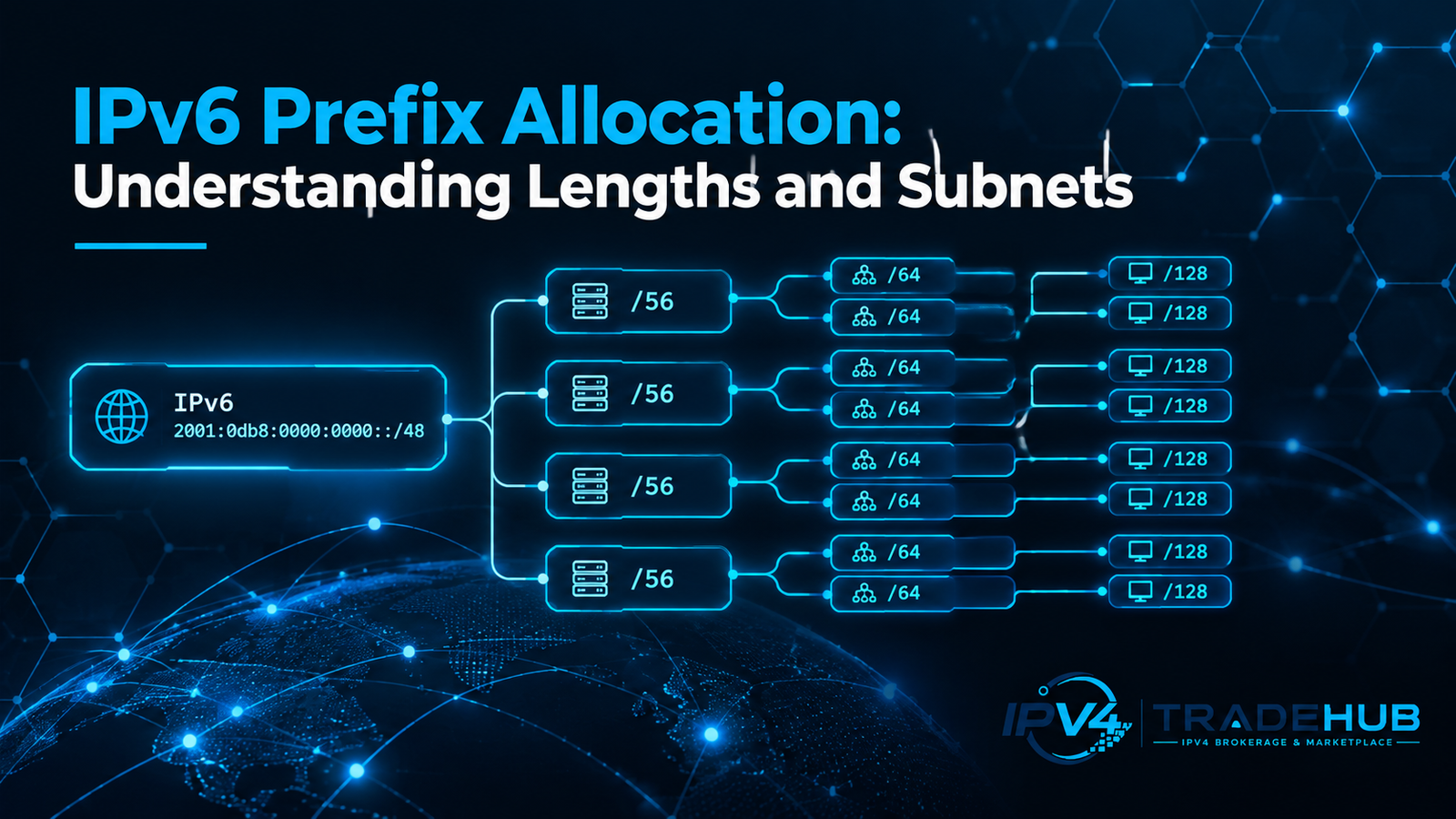
IPv6 prefix allocation is an essential concept in modern networking that helps organize and manage IP addresses efficiently. It defines how address blocks are divided into networks and subnets using prefix lengths, such as /48, /64, and /128. Understanding prefix lengths enables network administrators to allocate addresses systematically, support network growth, improve routing efficiency, and simplify network management. Proper IPv6 subnetting also ensures better scalability and flexibility in large-scale networks.
Understanding IPv6 Prefix Allocation
IPv6 prefixing is a system to divide an IPv6 address space between networks, devices and organizations. The IPv6 address is 128 bits in size, i.e., a big number of distinct addresses. Above all, the prefix is the network segment of a network address used, having an expression of slash notation in / 48 or / 64. The Internet service providers largely receive huge portions of prefixes that come in smaller portions for the customers.
Organizations can use prefixes to assign to a whole department, a building or a distinct network. The correct prefixing ensures that the management of the network is simple and allows future expansion. Hence, it also allows the administrators to structure addresses effectively, without using address space that might be of more value in the long run.
How IPv6 Prefix Lengths Work?
The IPv6 prefix length demonstrates the number of bits of an address that designate the network. It comes after a slash, e.g., /64. IPv6 addresses are 128 bits and therefore a /64 prefix has 64 bits to the interface identifier. Above all, this will give an incredibly huge address space in a single subnet. A /48 prefix has more network address space in which to form more subnets than a /64 prefix.
The smaller the prefix numbers, the larger the address blocks, and the larger the numbers, the smaller the address blocks. Knowledge to lease IPv6 subnet assists the network administrator in assigning addresses in a correct manner, constructing subnets, as well as planning networks which may be expanded in future.
How Prefix Length Affects Address Availability?
IPv6 prefix length directly impacts the number of addresses available to a network. A shorter prefix gives a bigger address block, whereas a longer prefix gives a smaller address block. An example is that a /48 prefix has 65,536 distinct /64 networks. There is 2^64 possible values for the interface identifier in each /64 subnet. It is this huge address space that makes IPv6 appropriate for the home, business, data center, and any device connected to the internet.
Nevertheless, availability of addresses is not just a matter of the number of addresses. Administrators have to keep in mind the subnet requirements, network design and expansion in the future. Hence, addressing the use of a suitable prefix will assist in avoiding any unnecessary complexity and facilitate effective and structured address handling.
IPv6 Subnetting Explained: How it Works?
Subnetting of IPv6 addresses means that there is a partition of larger address block into smaller networks, popular as subnets. This assists organizations in isolating devices, departments or services, as well as maintaining the organization of networks. An example is that an organization having a /48 prefix can generate 65,536 /64 subnets. The number of interface identifiers gets a support from each subnet.
Network administrators apply various prefixes to offices, servers, wireless and guest connections. Subnetting in IPv6 is typically by default /64 in normal LANs, compared to the customary IPv4 subnetting. Well-defined subnetting allows better organization of the network, thus simplifies the process of managing the network. Above all, it is easy to add more infrastructure in case more networks are required.
Best Practices of IPv6 Prefix Allocation for Beginners
Choose the Right Prefix Length
Select prefix lengths based on your network needs. This will also count when you lease IPv6 addresses. In the case of most typical IPv6 LANs, /64 is advisable. Smaller organizations can be allocated a /48 or /56, which can then have numerous subnets. Careful planning of prefix sizes simplifies network management and allows expansion in the future.
Better Future Growth
Always allocate time and space for the growth of devices, departments and services. Do not allocate all possible subnets simultaneously. An elastic IPv6 plan enables your network to grow without making significant modifications. Plan ahead and identify the future places, new systems and new requirements of connectivity.
Maintain Address Allocation
Become familiar with how to write the prefixes and subnet assigned, and their usage. Assign similar sort of naming system to departments, buildings and network segments. This will help the administrators both recognize the range of available addresses, and in troubleshooting any connection issues.
Adhere to Standard IPv6 Requirements
Make plans with standard requirements to learn the rules of IPv6 lease time. Give the prefix /64 the usual LAN subnets. Use the same allocation guidelines, use routers properly, and check assignments on a regular basis. Standard practices facilitate compatibility, reduce the hassle of troubleshooting and promote successful network operation.
FAQs: Commonly Asked Questions
1. What does /64 mean in IPv6?
A /64 prefix means the first 64 bits identify the network prefix, leaving 64 bits for interface identifiers within that subnet.
2. Why is /64 commonly used for IPv6 subnets?
IPv6 standards generally recommend /64 prefixes for conventional LANs because they support standard address autoconfiguration mechanisms and predictable network design.
3. How many subnets can a /48 IPv6 allocation provide?
A /48 can be divided into 65,536 separate /64 subnets, giving organizations considerable flexibility for sites, departments, and network segments.
Plan Smarter for the Future of IP Addressing
IPv6 is shaping the future of internet connectivity, and understanding prefix allocation is the first step toward building scalable networks. Explore IPv4 TradeHub to stay informed about IP resources, address management, and industry developments. Strengthen your technical knowledge, make informed infrastructure decisions, and prepare your organization for the evolving demands of modern networking.