
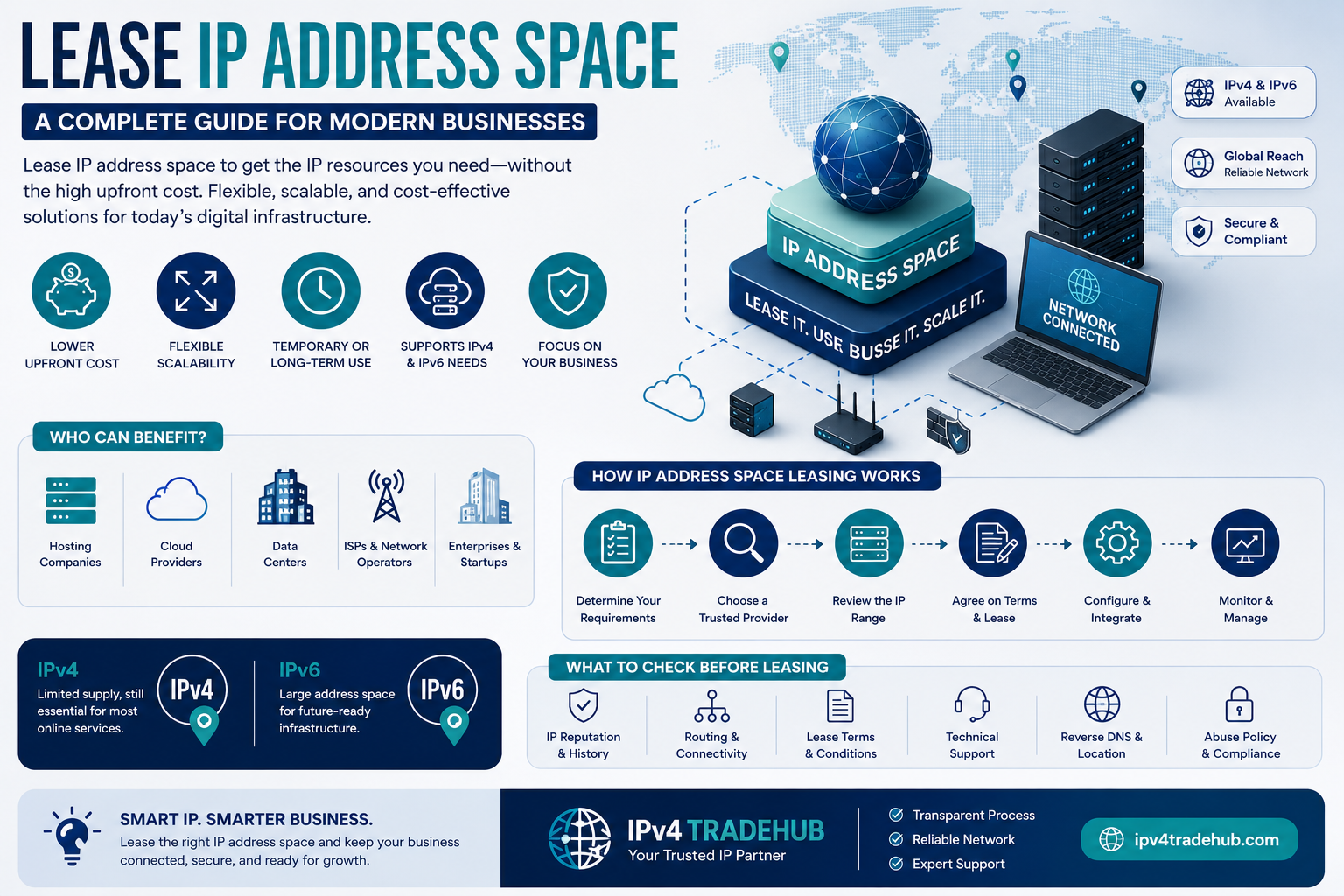
As businesses expand their digital infrastructure, having access to reliable IP addresses becomes increasingly important. Websites, cloud platforms, servers, applications, remote systems, and other online services all depend on IP addressing to communicate across networks. However, obtaining the right amount of address space can be challenging, particularly for organizations that need additional resources without making a large upfront investment.
This is where the option to lease IP address space can provide a practical solution. Instead of purchasing IP resources outright, businesses can obtain access to an allocated range for an agreed period. This approach can offer greater flexibility, predictable costs, and easier network expansion.
In this guide, we will explain what IP address space leasing means, how it works, its benefits, what businesses should consider before choosing a provider, and how it can support different types of network infrastructure.
What Is IP Address Space?
IP address space refers to a collection or range of Internet Protocol addresses used to identify devices and systems connected to a network. Every publicly reachable device or service generally needs an address that allows other systems to communicate with it.
There are two major versions of Internet Protocol currently used:
- IPv4
- IPv6
IPv4 uses 32-bit addresses and provides a finite address pool. IPv6 uses 128-bit addresses and was developed to provide a vastly larger addressing capacity. IANA maintains separate registries for both IPv4 and IPv6 address space and coordinates the allocation of Internet number resources through the Regional Internet Registries.
Address space is generally organized into blocks or prefixes rather than individual addresses. Businesses can therefore obtain a suitable block depending on their technical requirements and network design.
What Does It Mean to Lease IP Address Space?
To lease IP address space means obtaining temporary use of a block of IP addresses from a provider under agreed terms.
The business does not necessarily become the permanent owner of the address resources. Instead, the provider makes the agreed address range available for use during the lease period. The exact terms can vary depending on the provider, address type, geographic requirements, routing arrangements, and size of the requested block.
For example, a company may require additional public IP addresses for servers, cloud infrastructure, network expansion, or other online applications. Purchasing a large address block may not be suitable for its budget or long-term plans. Leasing can allow the company to obtain the required resources without committing to a permanent purchase.
The arrangement normally includes details such as:
- Number of IP addresses
- IP version
- Lease duration
- Monthly or periodic pricing
- Geographic or regional requirements
- Routing requirements
- Reverse DNS options
- Abuse and reputation policies
- Renewal conditions
Understanding these terms before entering an agreement helps businesses avoid unexpected costs or technical limitations.
Why Do Businesses Lease IP Address Space?
There are several reasons why organizations choose leasing instead of purchasing.
1. Lower Upfront Commitment
Purchasing IP resources can require a significant upfront investment, particularly when a business needs a larger block. Leasing can spread the cost over a defined period and make budgeting easier.
This can be useful for startups, growing companies, hosting businesses, and organizations testing new infrastructure.
2. Flexible Network Expansion
Business requirements can change quickly. A company may need additional addresses when launching new services, expanding its server infrastructure, or entering a new market.
Leasing provides a way to obtain additional resources without permanently committing to a large address block.
3. Suitable for Temporary Projects
Not every network project is permanent. Businesses may require additional IP resources for a limited period while running a development environment, migration project, cloud deployment, testing infrastructure, or temporary service.
A lease can align the availability of address space with the project’s expected duration.
4. Easier Resource Management
Working with an experienced IP provider can simplify the process of obtaining and managing address space. Instead of dealing with every aspect of address resource administration independently, a business can work through a structured leasing arrangement.
5. Access to IPv4 Resources
IPv4 remains important because many existing networks, applications, and systems continue to depend on it. IANA’s current allocation information notes that the global IPv4 supply has been exhausted at the IANA level, with recovered address space handled through the Regional Internet Registries.
This limited availability has increased the importance of efficiently managing existing IPv4 resources. Leasing can give businesses another way to obtain access to IPv4 address space when direct allocation or purchasing is not practical.
IPv4 and IPv6 Address Space Leasing
Businesses may have different requirements depending on their network architecture.
For organizations that depend on established IPv4 infrastructure, lease ipv4 addresses can be an option when additional public addresses are required for operational purposes.
IPv6 provides a substantially larger address space and is increasingly important for organizations planning long-term network growth. Businesses with IPv6-compatible infrastructure can also lease ipv6 addresses when they require additional IPv6 resources for deployment.
The appropriate choice depends on factors such as existing infrastructure, customer requirements, application compatibility, network provider support, and future expansion plans.
For many organizations, supporting both protocols can be a sensible strategy. A dual-protocol approach can help businesses maintain compatibility with existing IPv4 environments while preparing for continued IPv6 adoption.
How Does IP Address Space Leasing Work?
The leasing process is generally straightforward, although specific procedures vary between providers.
Step 1: Determine Your Requirements
Start by identifying how many addresses you need and what they will be used for.
Consider:
- IPv4 or IPv6 requirements
- Number of addresses
- Expected traffic
- Server locations
- Routing requirements
- Required lease duration
- Geographic preferences
- Reverse DNS requirements
Avoid requesting significantly more address space than necessary. A clear requirement helps the provider recommend an appropriate block.
Step 2: Select a Provider
Research providers that offer the type and quantity of IP resources you require.
Look at their reputation, support, pricing, network information, lease terms, and policies before making a decision.
Step 3: Review the IP Range
Before deployment, ask for information about the proposed address range. Depending on your use case, you may want to check whether the addresses have an acceptable history and whether they meet your technical requirements.
IP reputation can be particularly important for organizations operating email servers, security systems, advertising platforms, or other services where address reputation can affect deliverability and access.
Step 4: Configure the Address Space
Once the agreement is completed, the provider can provide the necessary configuration and routing information.
Your network team can then configure the addresses on the appropriate servers, routers, cloud environments, or other infrastructure.
Step 5: Monitor and Manage the Resources
After deployment, monitor the address space regularly. Keep track of utilization, routing, abuse reports, reputation, and other network indicators.
Good monitoring can help identify problems before they affect business operations.
What Should You Check Before Leasing IP Address Space?
Choosing a provider based only on price can create unnecessary problems. Businesses should consider several factors.
IP Reputation
Check whether the provider has processes for maintaining address quality and handling abuse reports. Poor IP reputation can create operational problems for certain services.
Routing and Connectivity
Confirm how the address range will be routed and whether the provider’s network arrangements are compatible with your infrastructure.
Lease Terms
Read the agreement carefully. Pay attention to the minimum lease period, renewal terms, cancellation conditions, deposits, and additional charges.
Technical Support
Reliable support can be important when configuring or troubleshooting an IP range. Determine what support is included and how technical issues are handled.
Geographic Requirements
Some businesses need IP resources associated with a particular region. If location matters for your application, confirm the provider’s available options before signing an agreement.
Reverse DNS
If your application requires reverse DNS configuration, check whether the provider supports it and understand how the process works.
Abuse Management
A professional provider should have a clear abuse-handling process. This helps protect the reputation and operational stability of the address range.
Who Can Benefit From Leasing IP Address Space?
IP address leasing can be useful for a wide range of organizations.
Hosting Companies
Hosting providers may require additional address resources as they add servers and customers.
Data Centers
Data centers can use leased address space to support infrastructure deployed for different customers and applications.
Internet Service Providers
Network operators may require additional address resources as their customer base and infrastructure grow.
Cloud Businesses
Cloud platforms often need flexible addressing options for servers, virtual machines, and other services.
Enterprises
Large organizations may need additional address space during infrastructure expansion, acquisitions, migrations, or major technology projects.
Startups
Smaller companies can avoid committing significant capital to address resources they may not need permanently.
Lease vs Buy: Which Option Is Better?
There is no universal answer because the right approach depends on the organization’s objectives.
Leasing may be more suitable when:
- You need IP resources quickly.
- Your requirement is temporary.
- You want predictable periodic costs.
- You are testing a new infrastructure project.
- You want flexibility as your requirements change.
Purchasing may be more suitable when:
- You need the resources for a long period.
- You want greater long-term control.
- The investment makes financial sense for your organization.
- You have a stable and predictable requirement.
Businesses should compare the total long-term cost of both options rather than looking only at the initial price.
How IPv4 TradeHub Can Help
Choosing the right IP address provider is an important part of building dependable network infrastructure. IPv4 TradeHub provides IP-related solutions designed to help businesses obtain the resources they need for their network requirements.
Before choosing an address range, businesses should clearly define their technical needs, evaluate provider policies, understand pricing, and verify the conditions associated with the resources.
You can learn more about available IP solutions through IPv4 TradeHub.
Final Thoughts
The option to lease IP address space gives businesses a flexible way to access Internet address resources without necessarily making a large permanent investment. It can be particularly useful for organizations with changing requirements, temporary projects, growing infrastructure, or a need for additional public IP resources.
The most important step is choosing the right address range and provider. Consider IP reputation, routing, pricing, lease terms, technical support, geographic requirements, reverse DNS, and abuse management before making a decision.
As businesses continue expanding their online infrastructure, effective IP address management will remain an important part of reliable network planning. Whether an organization is supporting existing IPv4 systems, preparing for IPv6, or operating a combination of both, a well-planned address strategy can make network expansion easier and more predictable.
Frequently Asked Questions
1. What does it mean to lease IP address space?
Leasing IP address space means obtaining temporary use of a defined range of IP addresses from a provider for an agreed period and under specific contractual conditions.
2. Why would a business lease IP addresses?
A business may lease addresses when it needs additional network resources without making a large upfront investment. Leasing can also be useful for temporary projects and growing infrastructure.
3. Can I lease both IPv4 and IPv6 address space?
Yes. Depending on the provider, businesses may be able to obtain either IPv4 or IPv6 resources based on their network requirements.
4. Is leasing IP address space better than buying?
It depends on your requirements. Leasing can provide flexibility and lower upfront costs, while purchasing may make more sense for organizations with long-term, stable requirements.
5. How long can IP address space be leased?
Lease periods vary by provider and agreement. Some arrangements may be short-term, while others can cover longer periods with renewal options.
6. Can leased IP addresses be used for servers?
Yes, leased public IP addresses can be used for suitable server and network applications, provided the intended use complies with the provider’s terms and technical requirements.
7. Does IP reputation matter when leasing IP address space?
Yes. IP reputation can be important for services such as email, security systems, and other applications where an address’s historical reputation may affect deliverability or access.
8. Can leased IP addresses be used for cloud infrastructure?
They can be suitable for certain cloud infrastructure requirements, depending on the cloud provider, routing arrangement, and terms associated with the leased address space.
9. What should I check before leasing IP address space?
Check the provider’s reputation, pricing, lease terms, routing arrangements, IP history, technical support, reverse DNS options, geographic requirements, and abuse policies.
10. How do I choose the right amount of IP address space?
Start by identifying your current and expected requirements. Consider the number of systems, services, servers, and future deployments that will require public addressing, then choose a block that provides appropriate capacity without unnecessary excess.