
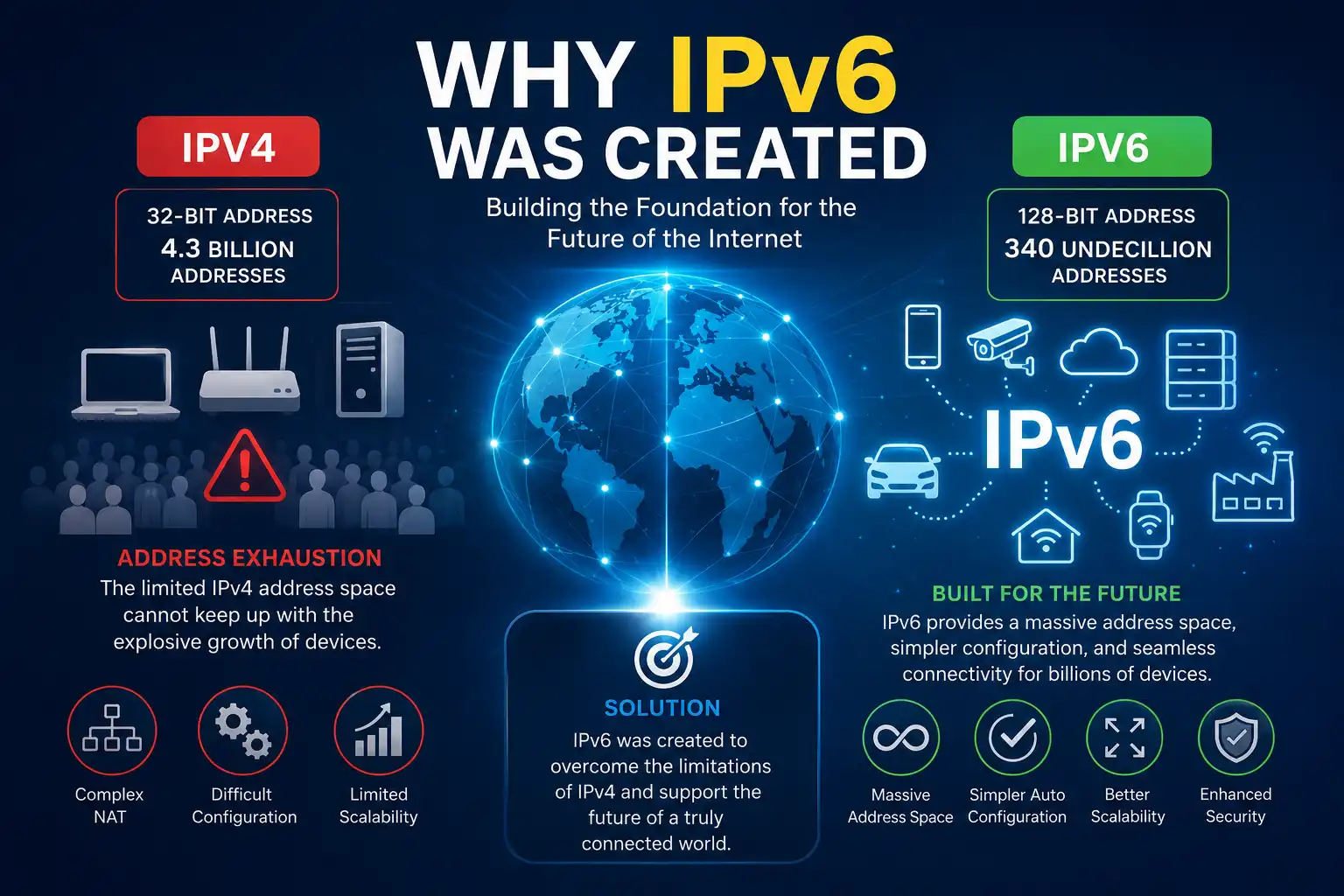
The internet has grown from a small network connecting a limited number of computers into a global infrastructure supporting billions of devices. Every device connected to the internet needs an IP address to communicate with other devices. For decades, IPv4 has provided this addressing system, but its limited address space eventually became a major challenge.
So, why was IPv6 created? IPv6 was developed primarily to solve the shortage of IPv4 addresses and provide a much larger, more flexible addressing system for the growing internet. It also introduced improvements in network configuration, routing, and support for modern internet-connected devices.
Understanding why IPv6 was created helps businesses, network administrators, developers, and organisations understand why the transition from IPv4 to IPv6 has become increasingly important.
What Is IPv6?
IPv6, or Internet Protocol version 6, is the latest major version of the Internet Protocol used to identify and communicate with devices across IP networks.
IPv6 uses 128-bit addresses, compared with the 32-bit addresses used by IPv4. This creates an enormous address space that can support the continued expansion of internet-connected devices.
An IPv6 address may look like this:
2001:0db8:85a3:0000:0000:8a2e:0370:7334
Unlike IPv4 addresses, which are written using four decimal numbers separated by periods, IPv6 addresses use hexadecimal characters separated by colons.
IPv6 was designed not simply as a replacement for IPv4, but as a long-term solution to several limitations that became increasingly apparent as the internet expanded.
The Main Reason IPv6 Was Created
The biggest reason IPv6 was created was the limited number of IPv4 addresses available.
IPv4 uses 32-bit addressing, providing approximately 4.3 billion unique addresses. That number may sound enormous, but it became insufficient as internet adoption expanded globally.
During the early development of the internet, nobody expected billions of smartphones, computers, servers, smart TVs, cameras, vehicles, industrial systems, and other connected devices to require network connectivity.
As more people and organisations connected to the internet, the available IPv4 address pool became increasingly scarce.
IPv6 solved this problem by expanding the address size from 32 bits to 128 bits.
IPv4 Address Exhaustion
IPv4 address exhaustion was one of the most important factors behind the development of IPv6.
The internet’s rapid commercialisation during the 1990s dramatically increased demand for IP addresses. Businesses began connecting networks, consumers started using home internet connections, and online services expanded worldwide.
Later, smartphones, cloud computing, IoT devices, connected appliances, and other technologies created even greater demand.
To slow down IPv4 exhaustion, several technologies and strategies were introduced, including:
- Network Address Translation (NAT)
- Private IPv4 addressing
- Classless Inter-Domain Routing (CIDR)
- More efficient address allocation
- IPv4 address transfers and market-based allocation
These approaches helped extend the useful life of IPv4, but they did not eliminate the fundamental limitation of its 32-bit address space.
IPv6 was created to provide a much larger and more sustainable addressing system.
How Many Addresses Does IPv6 Provide?
The difference between IPv4 and IPv6 address capacity is enormous.
IPv4 provides approximately 4.3 billion theoretical addresses. IPv6, with its 128-bit address structure, provides approximately 340 undecillion addresses.
That number is:
340,282,366,920,938,463,463,374,607,431,768,211,456
The enormous IPv6 address space makes it possible to assign addresses to an extremely large number of devices without facing the same scarcity experienced with IPv4.
This was particularly important as the internet moved toward an environment where almost anything could potentially become connected.
The Growth of Internet-Connected Devices
Another major reason IPv6 was created was the expected growth of connected devices.
When IPv4 was originally designed, the internet consisted of a relatively small number of connected systems. Today, connectivity is integrated into many areas of everyday life and business.
Examples include:
- Smartphones and tablets
- Cloud servers
- Security cameras
- Smart home devices
- Industrial equipment
- Vehicles
- Sensors
- Wearable technology
- Data centre infrastructure
- Internet of Things (IoT) devices
The continued expansion of these technologies requires an addressing system capable of supporting massive numbers of network endpoints.
IPv6 provides the address capacity needed for this growth.
IPv6 Reduces Dependence on NAT
Network Address Translation helped organisations conserve IPv4 addresses by allowing multiple devices to share a public IP address.
For example, a home network may have several computers, phones, and smart devices using private IPv4 addresses while sharing one public IPv4 address through a router.
NAT helped delay IPv4 exhaustion, but it also adds complexity to some network configurations.
IPv6 was designed with enough address space to make globally unique addressing practical at a much larger scale.
This does not mean NAT is completely irrelevant in every IPv6 environment, but IPv6’s large address space reduces the fundamental need to conserve addresses in the same way as IPv4.
Easier Network Configuration
IPv6 also introduced improved mechanisms for configuring devices on networks.
One important feature is Stateless Address Autoconfiguration (SLAAC). It allows compatible devices to automatically configure IPv6 addresses based on information provided by the network.
This can simplify network deployment and reduce the amount of manual configuration required in certain environments.
IPv6 can also work with DHCPv6 when organisations require more centralised control over address configuration.
These capabilities make IPv6 useful for modern networks where large numbers of devices may need to connect and configure themselves efficiently.
Why IPv6 Is Important for IoT
The Internet of Things is another major reason IPv6 has become increasingly relevant.
IoT involves connecting physical devices and sensors to networks so they can collect, exchange, or process information. A large-scale IoT deployment could involve thousands or millions of individual devices.
With IPv4, address scarcity can make large deployments more complicated, particularly when devices require direct addressing or organisations need to manage large numbers of endpoints.
IPv6 provides a massive address pool, making it much easier to design networks capable of supporting future IoT growth.
IPv6 Improves Network Scalability
Modern businesses often operate across multiple offices, cloud environments, data centres, remote locations, and connected services.
As networks become larger, address management becomes increasingly important.
IPv6 provides a hierarchical addressing structure that can support efficient network design and routing. Organisations can allocate address ranges according to their network architecture rather than trying to work within the much smaller IPv4 address space.
This can make it easier to plan networks for future expansion.
For businesses that need additional IP resources, IPv4 TradeHub provides solutions for organisations managing IPv4 and IPv6 requirements, including options to buy, lease, and rent IP resources.
IPv6 Was Designed for the Future of the Internet
One important point is that IPv6 was not created because IPv4 suddenly stopped working.
IPv4 remains widely used today.
Instead, IPv6 was developed because the internet was evolving beyond what the original IPv4 addressing model could comfortably support.
The goal was to create a protocol that could accommodate decades of future growth.
The development of IPv6 considered the increasing number of networks, users, applications, and connected devices that would need internet connectivity.
Its much larger address space provides a foundation for continued expansion.
What Are the Main Differences Between IPv4 and IPv6?
IPv4 and IPv6 both provide IP-based communication, but they differ significantly.
| Feature | IPv4 | IPv6 |
|---|---|---|
| Address size | 32-bit | 128-bit |
| Address format | Decimal | Hexadecimal |
| Address capacity | About 4.3 billion | About 340 undecillion |
| Address configuration | Manual/DHCP | SLAAC/DHCPv6/manual |
| Broadcast | Supported | Replaced by multicast mechanisms |
| Address scarcity | Major limitation | Extremely large address space |
| Header design | Variable length | Fixed base header |
These differences demonstrate why IPv6 was created as a long-term evolution of internet addressing.
Is IPv6 Replacing IPv4?
IPv6 adoption is continuing, but IPv4 has not disappeared.
For many organisations, the transition is gradual. Networks may operate IPv4 and IPv6 simultaneously using a dual-stack approach.
Other transition technologies can also allow IPv4 and IPv6 systems to communicate in different network environments.
The coexistence of both protocols means businesses do not necessarily need to replace their entire infrastructure immediately. Instead, they can develop an IPv6 adoption strategy based on their network requirements.
Why Businesses Should Prepare for IPv6
Businesses that rely heavily on internet connectivity should understand how IPv6 could affect their future network requirements.
Preparing early can help organisations:
- Plan future network expansion
- Understand IPv6 addressing
- Support newer network environments
- Prepare for IoT growth
- Reduce dependence on limited IPv4 resources
- Improve long-term IP address management
- Maintain compatibility with IPv6-enabled services
Businesses may also need to review their hardware, software, applications, security policies, DNS configuration, and hosting environments before implementing IPv6.
IPv6 and IP Resource Management
As organisations expand their networks, IP address management becomes an important consideration.
Businesses may require IP resources for servers, applications, networking infrastructure, cloud environments, testing, and other legitimate business purposes.
Depending on the project, organisations can explore different approaches to obtaining IP resources. For example, companies may choose to lease IPv6 resources when they need flexibility rather than making a long-term commitment.
Businesses should always evaluate provider reputation, routing requirements, address ownership, technical support, and usage policies before obtaining IP resources.
The Future of IPv6
The long-term importance of IPv6 is closely connected to the continued growth of the internet.
Cloud computing, mobile connectivity, IoT, automation, smart infrastructure, and other technologies continue to increase the number of devices and services requiring network connectivity.
IPv4 will remain an important part of the internet for many years, but its limited address space means organisations increasingly need to understand IPv6.
For companies building new networks, supporting modern infrastructure, or planning long-term expansion, IPv6 knowledge can be an important part of network planning.
Businesses interested in IP-based services may also explore solutions such as buy IPv6 proxies, depending on their specific technical and business requirements.
Final Thoughts
So, why was IPv6 created? The primary reason was to solve the limitations of IPv4, particularly its restricted address space.
IPv6 provides a 128-bit addressing system capable of supporting an enormous number of unique IP addresses. Beyond addressing capacity, it introduces features designed to support scalable network configuration, modern connectivity, and the continued expansion of internet infrastructure.
IPv4 is still widely used, and the transition to IPv6 is not happening overnight. However, IPv6 provides the long-term foundation needed for a growing and increasingly connected digital world.
For organisations managing IP resources, understanding both protocols is important. Whether a business needs IPv4 resources today or is preparing for greater IPv6 adoption, having a clear IP strategy can help support reliable and scalable network infrastructure.
Frequently Asked Questions About Why IPv6 Was Created
1. Why was IPv6 created?
IPv6 was created primarily to address the shortage of IPv4 addresses. Its 128-bit address space provides an enormous number of unique addresses for the continued growth of the internet.
2. What problem does IPv6 solve?
IPv6 primarily solves the IPv4 address exhaustion problem. It also provides improved mechanisms for addressing, network configuration, routing, and supporting large numbers of connected devices.
3. Why does IPv6 have 128-bit addresses?
IPv6 uses 128-bit addresses to provide a vastly larger address space than IPv4’s 32-bit addressing system. This allows the internet to support an extremely large number of devices.
4. Is IPv6 better than IPv4?
IPv6 was designed to overcome several limitations of IPv4, especially address scarcity. However, both protocols are still widely used, and whether IPv6 is more suitable depends on a network’s infrastructure and requirements.
5. Will IPv6 completely replace IPv4?
IPv6 is intended as the long-term successor to IPv4, but IPv4 remains widely deployed. Many networks currently use both protocols through technologies such as dual-stack networking.
6. How many IPv6 addresses are available?
IPv6 provides approximately 340 undecillion possible addresses because it uses a 128-bit address space. This is vastly larger than the approximately 4.3 billion theoretical IPv4 addresses.
7. Why is IPv6 important for IoT?
IoT can involve huge numbers of connected devices. IPv6 provides enough address capacity to support large-scale deployments without relying on the limited IPv4 address space.
8. Does IPv6 make NAT unnecessary?
IPv6’s huge address space reduces the need to conserve public IP addresses through NAT. However, specific network architectures may still use address translation or related technologies where appropriate.
9. Can businesses use IPv4 and IPv6 together?
Yes. Businesses can operate IPv4 and IPv6 simultaneously using a dual-stack network. This allows organisations to gradually introduce IPv6 while continuing to support IPv4 systems.
10. Should businesses start preparing for IPv6?
Businesses that depend on internet infrastructure should understand their IPv6 requirements and assess their networks, applications, hardware, security systems, and hosting environments as part of long-term planning.