
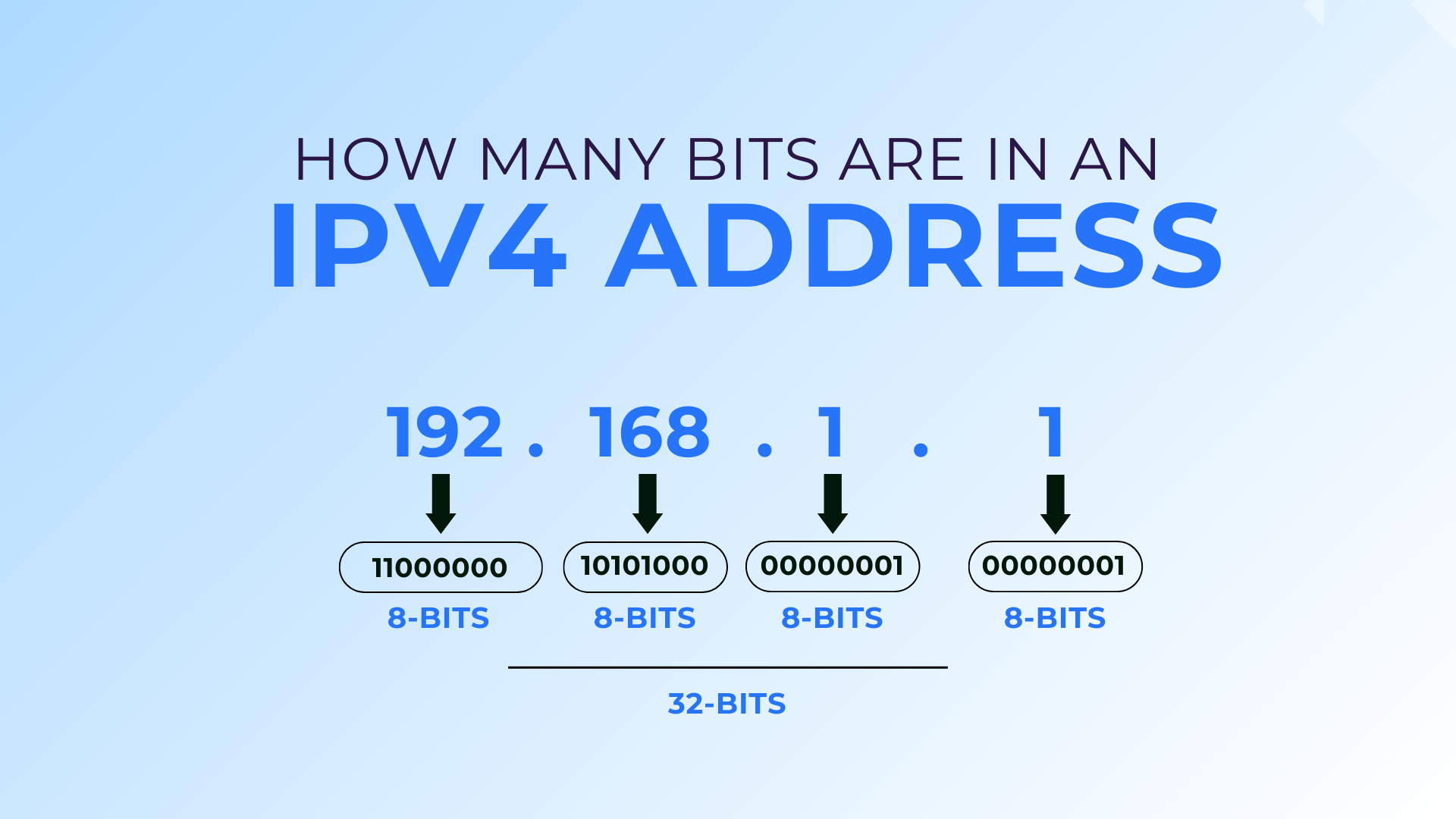
An Internet communication system enables devices globally to communicate and share data via networks. Each device must have a unique IP address so it is easy to identify and communicate with the others. Although fast-forwarding to the future, IPv6 is rapidly picking up steam; its predecessor, IPv4, remains the most common Internet protocol. One of the most common questions is “ how many bits is IPv4?” The following article describes an IPv4 structure, binary format, octets, address classes, and how it is helpful in networking.
How Many Bits Is IPv4? Structure Explained
IPv4 generates each IP address on the Internet with 32 bits. These 32 bits are available into four sections known as octets. There are 8 bits in each octet. Each of the four octets comes in a separation of dots, for example, 192.168.1.1. Each octet can hold between 0 and 255. These addresses are read by the computer in binary code, which is available in 0s and 1’s.
People prefer the dotted decimal notation due to its ease of reading and remembering. When address space is common with a 32-bit structure, IPv4 can use more than 4 billion unique addresses. This system is connect through computers, phones, and numerous devices together around networks and the Internet for many years.
Understanding IPv4 Address Structure
An IPv4 address consists of four sets of numbers separated by “dots”. An octet consists of 8 bits, and there are 4 octets. Together, the four octets make a total of 32 bits. An example of an IPv4 address is 172.16.0.1. Each octet may be in the range from 0 to 255. An address is available in two components: The network component and the host component.
The network portion specifies a particular network, and the host portion specifies a particular device associated with that network. This configuration is common among routers to route the data to its final destination. It was a simple design that made IPv4 easy and significant for internet communications all over the world.
Main Purpose of IPv4 for Using 32 Bits
When you are buying IPv4 block, know that the primary purpose of using 32 bits is to give sufficient unique addresses for devices on the networks. A 32-bit system can create more than 4 billion different IP addresses. It was seen as large enough when IPv4 was designed, and for the future growth of the Internet. The 32-bit format also leaves the addresses simple and easy to process by computers. It allows routers to easily detect networks and devices to transfer data. Hence, it uses resources efficiently and effectively, with minimal use of memory and processor.
Common Applications of IPv4 Today
Many networks and web services are still using IPv4 in 2026. Home Internet connections typically assign the IPv4 address to computers, smartphones, smart televisions, and gaming systems. Businesses also use IPv4 for office networks, websites, e-mail services, and cloud communication. A lot of routers and network devices can handle IPv4. It can be used to have a website pop up when you browse a site, stream a video, play online, and connect to servers all over the world.
IPv4 addresses are still being given to users by ISPs, as many systems are still relying on them. Although IPv6 is gaining ground, IPv4 is still vital because of its ability to provide interoperability for the legacy network infrastructure.
Difference Between IPv4 and IPv6 Bit Structures
Address Length and Size
The IP address is a 32-bit address, and there are approximately 4.3 billion different addresses that can be used with IPv4. IPv6 adopts a structure of 128 bits, which provides a much greater number of addresses for today’s internet devices. The longer network vendors will have to deal with the future of the Internet. With the world’s rapidly shrinking supply of IP addresses, the longer will be the time that the longer bit structure of IPv6 will do its job.
Binary Representation Format
Each bit to lease IPv4 address is in a particular 8-bit section called an octet, for instance, 192.168.1.1 with dots separating the bits. IPv6 is available in 128 bits into 8 pieces of 16 bits separated by colons. This is because the structure allows for more devices to be connected to the network. It would not be causing the range of IP addresses to grow significantly larger, and they are more powerful than IPv4.
Header Structure and Efficiency
The header format is much more complicated for IPv4, and there are multiple fields for error checking and fragmentation. IPv6 is a new version of the Internet Protocol that has a simplified header design that makes routing faster and network performance better. The streamlined design of IPv6 decreases the amount of computing required by routers and allows data to flow more quickly through network connections.
Addressing and Network Support
The IPv4 bit structure mainly supports unicast, broadcast, and multicast communication methods. IPv6 removes broadcast and focuses on unicast, multicast, and anycast communication for better efficiency. Its larger bit structure also improves security, automatic configuration, and support for advanced internet technologies and smart connected systems.
Unlock Premium IPv4 Assets with IPV4 TradeHub
Looking for secure IPv4 solutions for expanding network infrastructure? IPV4 TradeHub supports the trading of high-quality IPv4 blocks for businesses to purchase, sell, and lease with transfer security, expert support, and assistance. From the perspective of an ISP, hosting provider, cloud business, or enterprise scaling operations, our team makes the entire acquisition process comfortable and easy. Access to trusted inventory of IPv4, transparent pricing, and professional guidance for you.