
As businesses transition from IPv4 to IPv6, expanding connected devices, cloud services, and networks make IPv6 increasingly essential. Unlike IPv4, IPv6 has a vast 128-bit address space, offering 2¹²⁸ possible addresses versus IPv4’s 2³², so scarcity works differently. This raises an important question: can businesses simply buy IPv6 addresses like IPv4 addresses? Understanding the difference between IPv6 address allocation vs buying helps businesses make informed IP-resource decisions.
What IPv6 Address Allocation vs Buying Means?
IPv6 Address Allocation
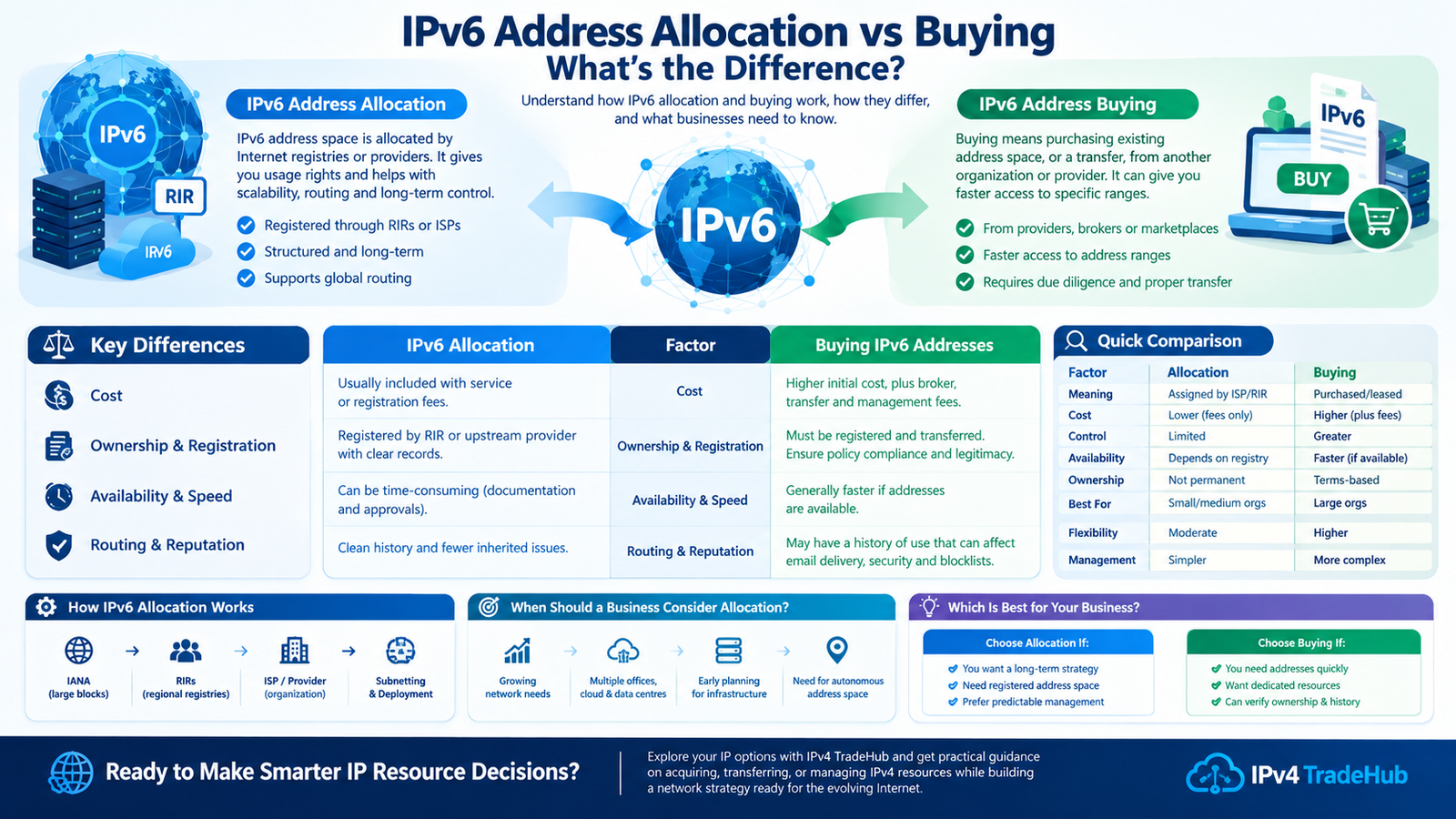
IPv6 address space is allocated by obtaining address space through reliable Internet registries or providers. Organizations usually acquire prefixes depending on their needs, as well as networking strategies. Allocation can confer justifiable ownership or usage rights, and help in forming orderly routing, scalability, and long-term control of IPv6 sources.
IPv6 Address Buying
The process to buy IPv6 address is the act of purchasing existing address space, or a transfer or marketplace deal, with another organization. This method helps to access particular address ranges faster than traditional allocation. Above all, buyers should ensure transfer eligibility, ownership records, reputation, as well as regional registration are met.
IPv6 Address Allocation vs Buying: Key Differences
Differences in Cost
The distribution of IPv6 is possible by registration, membership, provider, or administrative charges. Hence, purchasing can be very expensive in the form of high initial investments since good address space can be priced at a market price. Other costs might be broker fees, transfer fees, paperwork, as well as continuous registry or management fees.
Ownership and Registration
The registered allocated IPv6 space is usually registered by a suitable Internet registry or upstream provider, where clear records are formed regarding its allocation. Hence, the purchased address space should also be duly registered and transferred. Organizations are required to ensure that the transaction is in line with the policies of the registry and that it is a legitimate authorization.
Availability and Speed
Allocation may be time-consuming since organizations have to provide documentation, explain need, and undergo administrative processes. Purchasing existing IPv6 space can provide much quicker access by the time appropriate ranges can be moved. Nevertheless, the complexity of the transactions, approval of registries, and the quality of addresses can still influence the deployment schedules.
Routing and Reputation Considerations
Purchasing and allocating the IPv6 addresses requires careful routing and requires managing according to reputation. Furthermore, bought ranges can have a history of use that impacts email delivery, security surveillance, as well as blocklists. Organizations should do a history check prior to acquisition. New space can offer cleaner operations history as well as fewer inherited issues at times.
IPv6 Address Allocation vs Buying: Comparison Table
| Factor | IPv6 Address Allocation | Buying IPv6 Addresses |
| Meaning | Addresses are assigned by an ISP or regional registry. | Addresses are purchased or leased from a provider. |
| Cost | Usually included with service or registration fees. | Requires additional purchase or leasing costs. |
| Control | Limited by provider policies. | Greater control over address resources. |
| Availability | Depends on ISP/registry eligibility. | Generally faster if addresses are available. |
| Ownership | Often not permanently owned. | Terms depend on the purchase agreement. |
| Best For | Individuals, small businesses, and normal networks. | Large organizations needing dedicated address space. |
| Flexibility | Moderate. | Higher flexibility and portability. |
| Management | Simpler. | Requires more administrative management. |
How IPv6 Address Allocation Works?
The implementation to lease IPv6 addresses is based on a hierarchical approach. Internet Assigned Numbers Authority (IANA) allocates huge IPv6 blocks to Regional Internet Registries (RIRs), which allocate address resources to various regions. It depends on the circumstances under which organizations acquire IPv6 address space through their regional registry or an Internet service provider.
Above all, network requirements of the organization can assist in deciding on an appropriate prefix size. The business then breaks down the address block into smaller subnets to use in offices, servers, applications, cloud environments, and any other network segments. The addresses can be used on the Internet when properly registered and routed. Hence, this is a structured process that can be used to avoid conflicts and ensure effective global IPv6 routing.
When Should a Business Consider IPv6 Allocation?
An organization should consider IPv6 allocation when its network is growing and it requires extra addresses, or it anticipates more influence over its future addressing plan. The allocation is particularly handy in the case of organizations that have several offices, data centres, cloud services, websites, or Internet-facing applications.
Companies intending to undertake significant infrastructure upgrades should also start thinking about IPv6 early and not when the demand for addresses is an urgent matter. This can be useful to companies that desire an autonomous address space to get the resources via the relevant Regional Internet Registry. They will need to evaluate their network size, technical needs, routing needs, budget, as well as future growth before applying. The planning of professional networks may assist in identifying the appropriate IPv6 prefix.
IPv6 Address Allocation vs Buying: Which Is Best?
The decision between IPv6 allocation and buying is determined by the business interests, budget, time span, and network specifications. Allocation is usually an excellent option when organizations require an organized, long-term strategy, registered address space, as well as predictable management. The process of purchasing or IPv6 selling can be appealing when a company is in need of addresses in a hurry or where the company needs dedicated address resources, but it must be thoroughly checked in terms of ownership, transfer rights, history, and contractual conditions.
The other considerations that businesses should look at include routing, reputation, current costs, and future scalability before making a decision. When infrastructure planning is long-term, it is common that the IPv6 space is easy to obtain from allocation channels.
FAQs: Commonly Asked Questions
1. Who allocates IPv6 addresses?
Regional Internet Registries are responsible for the allocation of IPv6 address space based on set policies and procedures in their respective regions of service.
2. Is IPv6 address space owned permanently?
IPv6 address space is not traditionally considered property with unlimited rights of permanent ownership, but instead, as licensed Internet number resources.
3. Why is IPv6 easier to obtain than IPv4?
The address space of IPv6 is far larger, and scarcity pressures are much less than those experienced today with IPv4. This will help eliminate the competitive IPv4 secondary market.
Ready to Make Smarter IP Resource Decisions?
Whether your organization needs additional IPv4 capacity today or is preparing for long-term IPv6 adoption, choosing the right approach can protect your infrastructure and support future growth. Explore your IP options with IPv4 TradeHub and get practical guidance on acquiring, transferring, or managing IPv4 resources while building a network strategy ready for the evolving Internet.