
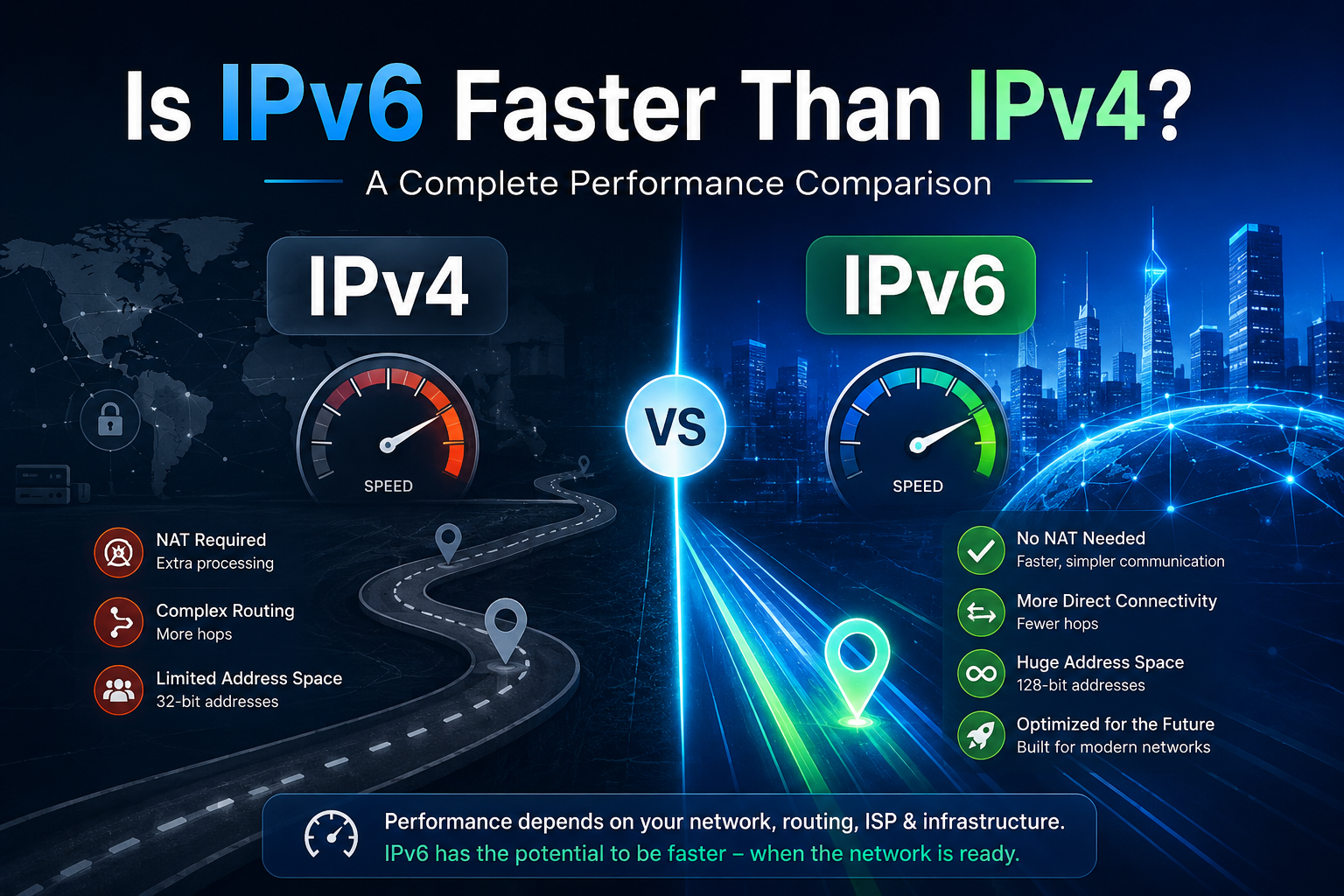
If you have ever wondered, is IPv6 faster than IPv4, the short answer is: sometimes, but not in every situation. IPv6 was designed as the next generation of the Internet Protocol, primarily to solve the limited address space of IPv4. However, its modern network architecture can also provide performance advantages in certain environments.
The actual speed difference between IPv6 and IPv4 depends on several factors, including your internet service provider, routing path, server location, network configuration, and whether additional translation technologies are being used.
As IPv6 adoption continues to grow, understanding its performance compared with IPv4 has become increasingly important for businesses, developers, hosting providers, and network administrators.
Is IPv6 Faster Than IPv4?
So, is IPv6 faster than IPv4? There is no universal answer.
In well-configured networks, IPv6 performance can be equal to or better than IPv4. Research into modern IPv6 network performance has found that IPv6 paths have become largely comparable to IPv4, with some measurements showing IPv6 performing better.
One reason is that IPv6 can provide a more direct path between networks and applications. IPv4 networks often rely heavily on Network Address Translation (NAT) because public IPv4 addresses are limited. IPv6 provides an enormous address space, allowing networks to assign globally unique addresses without requiring traditional NAT for basic connectivity.
However, IPv6 does not automatically make an internet connection faster. A poorly routed IPv6 connection can perform worse than a well-optimized IPv4 connection.
Therefore, it is more accurate to say that IPv6 has the potential to be faster or more efficient than IPv4, depending on the network environment.
Why Can IPv6 Be Faster Than IPv4?
Several characteristics can contribute to better IPv6 performance.
1. Less Dependence on NAT
One of the biggest differences between IPv4 and IPv6 is address availability.
IPv4 has a 32-bit address space, while IPv6 uses 128-bit addresses. This gives IPv6 an enormously larger pool of available addresses.
Because public IPv4 addresses are scarce, many devices access the internet through NAT. A private device may need its traffic translated through a router before reaching a public destination.
IPv6 can reduce the need for this type of address translation because devices can have globally routable IPv6 addresses.
Removing unnecessary translation can simplify communication paths and reduce potential processing overhead.
2. More Direct Connectivity
IPv6 was designed with end-to-end connectivity in mind.
In an IPv4 environment, several layers of infrastructure may be involved between a private device and an internet server. NAT, carrier-grade NAT, and other transition technologies can add complexity.
With native IPv6 connectivity, communication can potentially follow a more straightforward route.
This does not guarantee lower latency, but a simpler path can help reduce unnecessary processing and improve consistency.
3. Efficient Packet Processing
IPv6 has a redesigned packet header compared with IPv4. The IPv6 base header has a fixed length, while additional functionality is handled through extension headers.
This structure can make packet processing more predictable for modern networking equipment.
Routers still need to process IPv6 traffic efficiently, and actual performance depends on the hardware and software involved. Therefore, the protocol itself should not be viewed as a guaranteed speed upgrade.
4. Modern Network Infrastructure
Many newer networks have been designed with IPv6 support from the beginning.
Cloud providers, internet service providers, content delivery networks, and large technology companies increasingly support native IPv6 connectivity. Google Cloud, for example, supports both dual-stack and IPv6-only networking for supported services.
As infrastructure improves, IPv6 paths can become increasingly competitive with established IPv4 routes.
Why IPv4 Can Sometimes Be Faster
Although IPv6 offers several potential advantages, IPv4 can still outperform IPv6 in particular situations.
The most important factor is routing quality.
IPv4 has been deployed globally for decades, so its routing infrastructure is extremely mature. Some networks have highly optimized IPv4 paths while their IPv6 routes may take a different or less efficient path.
For example, if an IPv6 packet travels through a longer route between a user and a server, its latency may be higher than the IPv4 connection to the same destination.
APNIC’s ongoing measurements compare IPv4 and IPv6 round-trip times and show that differences are generally small across much of the world, although some regions have more noticeable variations.
This is why it is incorrect to assume that changing from IPv4 to IPv6 will automatically improve internet speed.
IPv6 vs IPv4: Latency Comparison
Latency measures how long it takes data to travel between two points on a network.
Lower latency generally means a faster response, which is particularly important for:
- Online gaming
- Video conferencing
- Cloud applications
- Remote desktop services
- Financial applications
- Voice communication
- Real-time APIs
IPv6 can deliver latency comparable to IPv4 when both protocols use efficient network paths.
In some situations, IPv6 may have a latency advantage because it avoids certain translation layers. In other cases, IPv4 may be faster because its routing path is more established.
Research tracking IPv6 performance has found that modern IPv6 data-plane performance can be comparable to or better than IPv4. Earlier measurements showed IPv6 often performing worse, demonstrating how significantly network maturity and routing can affect results.
Does IPv6 Improve Download and Upload Speed?
IPv6 itself does not increase the bandwidth provided by your ISP.
If your internet package provides 100 Mbps, switching from IPv4 to IPv6 will not suddenly turn that connection into 200 Mbps.
Instead, IPv6 can affect the efficiency of how your traffic reaches its destination.
For example, an IPv6 route may have:
- Lower latency
- Fewer translation steps
- Better routing
- Less network congestion
- More direct connectivity
When these conditions exist, users may experience faster page loading or improved responsiveness.
Cloudflare has previously reported faster connection and page-loading performance for IPv6 users in certain measurements, although results vary by network and deployment.
The key point is that IPv6 can improve network performance without increasing the underlying bandwidth of an internet connection.
Does IPv6 Make Websites Load Faster?
A website can potentially load faster over IPv6, but several components influence the final result.
The user’s device needs IPv6 connectivity, the ISP needs to support it, and the website or CDN needs to provide an IPv6 endpoint.
When both IPv4 and IPv6 are available, modern browsers can use connection-selection mechanisms such as Happy Eyeballs to choose a responsive path. APNIC explains that this mechanism compares connectivity and can select IPv4 when the IPv6 path is slower.
This means users do not necessarily have to manually choose between IPv4 and IPv6.
If a website has properly configured IPv6 connectivity and the user’s IPv6 route is strong, the IPv6 connection may provide an excellent browsing experience.
IPv6 and Network Congestion
Network congestion can have a much larger impact on performance than the IP protocol itself.
Two users with the same internet speed may experience completely different results because their traffic follows different routes.
IPv6 adoption has grown considerably, and Internet Society reported that native IPv6 access to Google services crossed 50% globally in March 2026.
As more networks use IPv6, its routing infrastructure continues to mature.
For businesses planning future network expansion, IPv6 can therefore provide an important foundation for supporting large numbers of connected devices without depending entirely on scarce IPv4 addresses.
Is IPv6 Better for Businesses?
For businesses, the decision between IPv4 and IPv6 should not be based on speed alone.
IPv6 offers a much larger address space, which can simplify network expansion and reduce dependence on scarce public IPv4 resources.
Organizations managing servers, cloud infrastructure, applications, IoT devices, or large networks may benefit from supporting IPv6 alongside IPv4.
Businesses that still require IPv4 connectivity can continue using IPv4 while gradually introducing IPv6 through a dual-stack environment.
For organizations that need additional IPv4 resources, solutions such as lease ipv4 addresses can provide access to IPv4 space without requiring an immediate purchase.
Similarly, businesses planning IPv6 deployments can explore options to lease ipv6 addresses when their infrastructure or operational requirements call for additional IPv6 resources.
The important point is to evaluate address requirements, routing, security, application compatibility, and provider support rather than choosing a protocol solely because it appears faster.
How to Test Whether IPv6 Is Faster for You
If you want to determine whether IPv6 is faster than IPv4 on your own network, perform controlled tests.
You can compare:
- Ping latency – Measure round-trip time over IPv4 and IPv6.
- Traceroute paths – Check how many network hops each protocol uses.
- Download performance – Test the same file through IPv4 and IPv6.
- Website loading – Compare websites that support both protocols.
- Connection stability – Monitor packet loss and response consistency.
- Different destinations – Test several servers rather than relying on one location.
Testing multiple destinations is important because IPv4 and IPv6 can follow completely different routes.
If IPv6 consistently provides lower latency and better stability, your network may benefit from prioritizing it where appropriate.
Should You Switch From IPv4 to IPv6?
For most organizations, switching does not have to mean abandoning IPv4 immediately.
A gradual transition is usually more practical. Many modern environments support both protocols through dual-stack networking.
IPv4 remains important because not every network or service supports IPv6. RIPE notes that IPv6 is not directly compatible with IPv4, meaning communication between the two protocols requires appropriate transition or translation mechanisms.
IPv6 should therefore be viewed as an important long-term networking technology rather than simply a faster version of IPv4.
Businesses can implement IPv6 while maintaining IPv4 compatibility and gradually increase IPv6 usage as their infrastructure and customers support it.
Final Verdict: Is IPv6 Faster Than IPv4?
So, is IPv6 faster than IPv4?
IPv6 can be faster than IPv4, but it is not inherently faster in every situation.
Performance depends on routing, ISP infrastructure, server configuration, network congestion, hardware, and transition technologies. Modern measurements show that IPv6 performance is generally comparable to IPv4 and can outperform it on some network paths.
The bigger advantage of IPv6 is not simply speed. Its huge address space, reduced dependence on NAT, support for modern network architectures, and long-term scalability make it an important part of the internet’s future.
For businesses, the best approach is to evaluate IPv4 and IPv6 based on actual network performance and operational requirements. With proper implementation, IPv6 can provide reliable connectivity today while preparing infrastructure for continued internet growth.
Frequently Asked Questions
1. Is IPv6 faster than IPv4?
IPv6 can be faster than IPv4 on some networks, but there is no universal speed advantage. Routing quality, ISP infrastructure, latency, congestion, and server connectivity all influence performance.
2. Does IPv6 reduce ping?
IPv6 can reduce ping when it provides a more efficient route to a destination. However, IPv6 does not automatically produce lower latency than IPv4.
3. Does IPv6 increase internet speed?
IPv6 does not increase your internet package’s bandwidth. However, a more efficient IPv6 route can sometimes improve responsiveness, connection time, and overall network performance.
4. Why can IPv6 be faster than IPv4?
IPv6 can avoid some NAT-related processing and provide more direct connectivity. When the IPv6 routing path is efficient, these factors can contribute to better performance.
5. Can IPv4 be faster than IPv6?
Yes. IPv4 can be faster when its routing path is shorter, better optimized, or less congested than the available IPv6 route.
6. Does IPv6 improve website loading speed?
It can. If both the website and user’s network have strong IPv6 connectivity, IPv6 may provide faster connection establishment or a more efficient route.
7. Should businesses use IPv6?
Businesses should strongly consider supporting IPv6 because of its scalability and large address space. A dual-stack deployment can allow businesses to maintain IPv4 compatibility while adopting IPv6.
8. Is IPv6 better for gaming?
IPv6 can provide good gaming performance when the network has a low-latency IPv6 route. However, gaming performance depends more on latency, routing, packet loss, and the game server than on IPv6 alone.
9. Is IPv6 more secure than IPv4?
IPv6 includes modern protocol features, but using IPv6 does not automatically make a network secure. Proper firewall configuration, monitoring, access controls, and security policies remain essential.
10. Will IPv6 replace IPv4 completely?
IPv6 adoption continues to increase, but IPv4 remains widely used. Because IPv4 and IPv6 are not directly compatible, transition is expected to involve dual-stack networks and other compatibility technologies for many years.