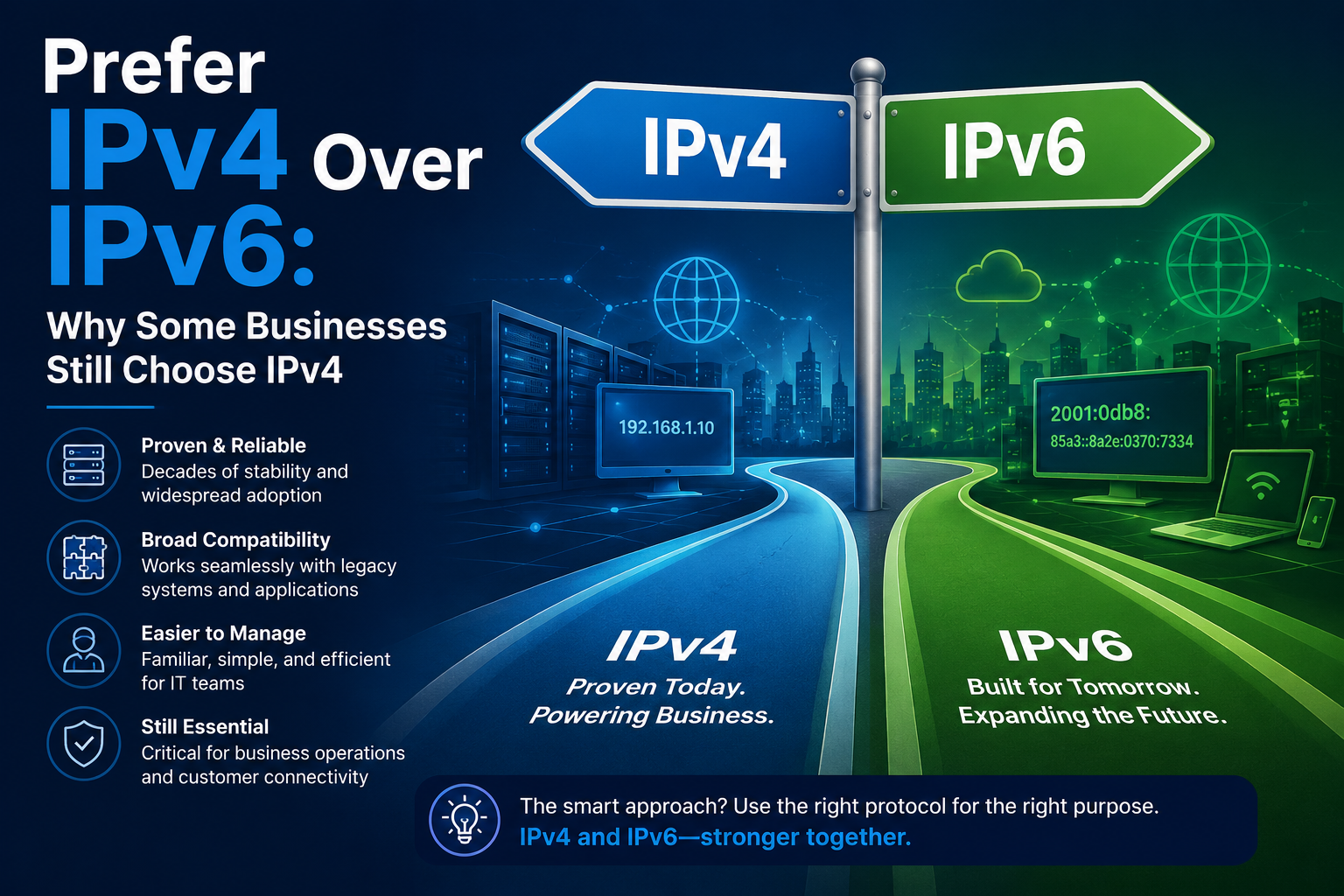
When it comes to internet connectivity, businesses today have more than one option. IPv4 remains deeply established across websites, cloud platforms, applications, enterprise networks, and other online infrastructure, while IPv6 continues to expand as organizations prepare for the future.
This creates an important question for businesses managing their network infrastructure: should you prefer IPv4 over IPv6?
There is no universal answer. IPv6 offers an enormous address space and is an important part of the long-term development of the internet. However, IPv4 still provides practical advantages for organizations that depend on existing infrastructure, applications, compatibility, and established network environments.
The decision should therefore be based on technical requirements rather than simply choosing the newer protocol.
What Does “Prefer IPv4 Over IPv6” Mean?
To prefer IPv4 over IPv6 means choosing IPv4 as the primary Internet Protocol for a particular network, application, server, or service when both protocols are available.
This does not necessarily mean avoiding IPv6 completely. Many modern networks operate with dual-stack configurations, allowing both IPv4 and IPv6 traffic to coexist.
IPv4 uses 32-bit addresses, while IPv6 uses 128-bit addresses. IPv6 was developed largely to solve the limited address space associated with IPv4. However, IPv4 has accumulated decades of infrastructure, software compatibility, operational knowledge, and business dependencies.
As a result, IPv4 remains relevant even as IPv6 adoption continues to grow. Internet organizations have also recognized that IPv4 and IPv6 are expected to coexist for an extended period rather than one protocol suddenly disappearing.
Why Do Businesses Still Prefer IPv4?
There are several reasons an organization may choose to prefer IPv4 over IPv6 for certain workloads.
1. Existing Infrastructure Supports IPv4
One of the biggest advantages of IPv4 is its maturity.
Routers, firewalls, servers, monitoring systems, applications, and network-management tools have supported IPv4 for many years. IT teams are generally familiar with IPv4 configuration, troubleshooting, subnetting, routing, and security practices.
Replacing or redesigning infrastructure simply to move to IPv6 can require additional planning, testing, training, and investment.
For a business whose existing infrastructure already performs reliably with IPv4, there may be little immediate operational benefit from completely replacing it.
2. IPv4 Compatibility Remains Important
Although IPv6 adoption is increasing, businesses cannot assume that every application, service, device, or customer environment operates identically over IPv6.
Legacy applications can be particularly important. Older systems may have been developed around IPv4 assumptions, including IPv4 address formats, firewall rules, access controls, monitoring tools, or application configurations.
A company that depends on such systems may prefer IPv4 because it provides predictable compatibility with its existing environment.
This is one reason dual-stack deployment remains an important transition strategy. Organizations can introduce IPv6 while continuing to support IPv4 rather than making an immediate all-or-nothing migration.
3. IPv4 Is Familiar to Network Administrators
IPv4 is easier to recognize and work with for many network professionals.
An address such as 192.168.1.10 is relatively straightforward to read and remember. IPv6 addresses are much longer and use hexadecimal notation, which can make manual configuration and troubleshooting feel more complicated.
This does not mean IPv6 is technically inferior. Rather, it reflects familiarity.
Network administrators who have spent years working with IPv4 may already have established procedures for:
- Address allocation
- Subnetting
- Firewall configuration
- Network monitoring
- Routing
- Troubleshooting
- Access control
- IP reputation management
Keeping IPv4 in an existing environment can therefore reduce operational disruption.
IPv4 Can Be Practical for Legacy Applications
Legacy software is another major reason organizations may prefer IPv4.
Some applications were designed when IPv4 was the standard networking environment. Even if an application technically supports IPv6 today, changing its configuration may require extensive testing.
Businesses often need to consider dependencies between applications, databases, APIs, firewalls, load balancers, and third-party services.
A small networking change can sometimes affect several connected systems.
For this reason, organizations may continue using IPv4 for applications that already work correctly while introducing IPv6 gradually in other parts of their infrastructure.
IPv4 Address Scarcity Has Changed the Market
There is an important contradiction surrounding IPv4.
IPv4 remains widely used, but the supply of new IPv4 address space is limited. Regional Internet Registries have already exhausted or substantially depleted their available pools in many regions, which has contributed to the development of a secondary market for IPv4 addresses.
This scarcity has given IPv4 addresses economic value.
Organizations that already own suitable IPv4 resources may therefore have an asset that remains useful for their infrastructure. Businesses that need additional addresses may consider obtaining them through established market mechanisms rather than immediately redesigning their systems around IPv6.
For companies that need additional IPv4 capacity without purchasing a permanent allocation, options such as lease ipv4 addresses can provide an alternative approach.
When Should You Prefer IPv4 Over IPv6?
Choosing IPv4 can make sense when your business has specific requirements.
Existing applications depend on IPv4
If important applications have been built around IPv4, keeping IPv4 available can prevent unnecessary compatibility problems.
Your customers primarily connect through IPv4
Customer connectivity should always be considered. If a significant portion of your audience or business partners still relies on IPv4, removing IPv4 support could create accessibility issues.
Your infrastructure is already optimized for IPv4
Businesses with mature IPv4 networks may prefer to maintain their current environment while gradually introducing IPv6.
Your security and monitoring tools are IPv4-focused
IPv6 deployment requires appropriate security policies, monitoring, logging, and configuration. Organizations should ensure their operational tools can properly support both protocols before making IPv6 the primary choice.
You need predictable compatibility
IPv4 remains a practical choice when compatibility with existing systems is more important than adopting a newer addressing protocol immediately.
Why You Should Not Completely Ignore IPv6
Although there are valid reasons to prefer IPv4, businesses should not interpret this as a reason to ignore IPv6.
IPv6 provides a vastly larger address space and addresses one of the fundamental limitations of IPv4. As more networks, devices, service providers, and applications support IPv6, its importance will continue to grow.
Industry documentation has consistently described IPv6 deployment as an important response to IPv4 exhaustion and long-term internet growth.
Businesses planning their infrastructure for the long term should therefore evaluate IPv6 rather than assuming IPv4 will remain the only protocol they need.
A sensible strategy for many organizations is gradual adoption.
IPv4 vs IPv6: Which Is Better for Your Business?
Instead of asking which protocol is universally better, businesses should ask which protocol fits their requirements.
| Factor | IPv4 | IPv6 |
|---|---|---|
| Address size | 32-bit | 128-bit |
| Address availability | Limited | Extremely large |
| Existing compatibility | Very high | Increasing |
| Infrastructure maturity | Very high | Growing |
| Address notation | Easier for many users | More complex |
| Long-term scalability | Limited address space | Excellent |
| Transition requirement | Existing standard | Increasingly important |
| Common deployment model | Established | Often dual-stack |
The right choice depends on your infrastructure, applications, customers, network strategy, and future requirements.
Can Businesses Use IPv4 and IPv6 Together?
Yes.
In fact, using both protocols can be a practical way to manage the transition.
A dual-stack environment allows devices and services to communicate using IPv4 and IPv6. This gives organizations the flexibility to maintain compatibility with existing IPv4 systems while preparing for increased IPv6 adoption.
The Internet Engineering Task Force has documented dual-stack as one of the important approaches used during IPv6 deployment.
This approach can also reduce the pressure of making a complete migration immediately.
For example, a business could maintain IPv4 for existing applications while enabling IPv6 for newer services, networks, or customers that support it.
IPv4 Can Still Be a Strategic Business Choice
The idea that IPv4 is simply outdated and should immediately be abandoned does not reflect how real-world networks operate.
IPv4 remains integrated into a huge amount of existing infrastructure. Businesses have invested in systems, applications, processes, and network architectures that depend on it.
At the same time, IPv6 is becoming increasingly important. Recent industry data shows that IPv6 adoption has reached significant levels, reinforcing the need for businesses to prepare for both protocols rather than treating the transition as a simple replacement.
For some organizations, continuing to use IPv4 is the most practical short-term decision. For others, expanding IPv6 support may be essential for long-term growth.
The strongest strategy is usually based on business requirements rather than protocol preference alone.
How to Manage IPv4 Resources Efficiently
If your organization continues to rely on IPv4, efficient address management becomes increasingly important.
Businesses should maintain accurate records of allocated addresses, monitor utilization, remove unnecessary assignments, and establish clear policies for network expansion.
Organizations that need additional address resources can also evaluate different acquisition and leasing models. Before obtaining IPv4 space, it is important to consider factors such as address reputation, registration information, routing requirements, provider policies, and intended use.
For organizations exploring IPv6 resources as part of a broader transition, options to lease ipv6 addresses may also be worth evaluating.
The key is to build an address strategy that supports current requirements without creating unnecessary technical debt.
Should You Prefer IPv4 Over IPv6?
In some situations, yes.
If your applications, customers, infrastructure, and operational tools depend heavily on IPv4, there can be practical reasons to continue prioritizing it.
However, that decision should not become a reason to delay IPv6 planning indefinitely.
IPv4 and IPv6 serve the same fundamental purpose but address very different stages of internet development. IPv4 offers extensive compatibility and an established ecosystem, while IPv6 provides the address capacity needed for continued internet expansion.
For many businesses, the most effective approach is not choosing one protocol permanently. Instead, it is maintaining reliable IPv4 services while developing an IPv6 strategy that can expand over time.
Final Thoughts
Businesses that prefer IPv4 over IPv6 are not necessarily rejecting modern networking. In many cases, they are responding to practical requirements involving compatibility, infrastructure, applications, and customers.
IPv4 remains commercially and technically relevant despite address exhaustion, while IPv6 continues to expand and solve the long-term limitations of the older protocol.
The best approach is to evaluate your current network carefully, understand your customers and applications, and plan a gradual transition where necessary.
If your business needs reliable IP address resources or wants to explore options for managing IPv4 and IPv6 requirements, IPv4 TradeHub can be part of your research into available IP address solutions.
Frequently Asked Questions
1. Why do businesses prefer IPv4 over IPv6?
Businesses may prefer IPv4 because of existing infrastructure, application compatibility, established network-management processes, and customer connectivity. IPv4 can remain practical when a company’s systems already depend heavily on it.
2. Is IPv4 better than IPv6?
Neither protocol is universally better. IPv4 offers mature compatibility and widespread support, while IPv6 provides a significantly larger address space and stronger long-term scalability. The appropriate choice depends on business requirements.
3. Is IPv4 still being used?
Yes. IPv4 remains widely used across enterprise networks, cloud infrastructure, websites, applications, and internet services. IPv4 and IPv6 continue to coexist.
4. Why was IPv6 created?
IPv6 was developed primarily to address the limited address space of IPv4. Its 128-bit addressing system provides an enormous number of possible addresses, supporting continued growth in internet-connected devices.
5. Can IPv4 and IPv6 work together?
Yes. Networks can use dual-stack configurations in which IPv4 and IPv6 operate simultaneously. This allows organizations to support existing IPv4 systems while introducing IPv6 capabilities.
6. Is IPv4 becoming obsolete?
IPv4 is not obsolete. Although IPv6 adoption is increasing, IPv4 remains important because of its extensive installed base and continued use across many networks and services.
7. Why are IPv4 addresses valuable?
IPv4 addresses have become valuable because the supply of globally routable IPv4 address space is limited. Organizations that need additional addresses may therefore turn to secondary-market transactions or leasing arrangements.
8. Should a business switch completely from IPv4 to IPv6?
A complete switch may not be appropriate for every business. Organizations should first assess applications, infrastructure, customers, security tools, and connectivity requirements before deciding how quickly to transition.
9. Can I use IPv4 for existing applications and IPv6 for new services?
Yes. Businesses can gradually introduce IPv6 while maintaining IPv4 for applications that still depend on it. This can provide a more controlled transition than replacing the entire network at once.
10. What should businesses consider before choosing IPv4 or IPv6?
Businesses should consider compatibility, address requirements, infrastructure, application support, customer connectivity, security, monitoring, operational costs, and long-term network plans before selecting a preferred protocol.